A Free State?
Let us start from the beginning. To understand the nature of the beast, you must understand how the beast was raised. Indiana was a free state in the sense that it wouldn’t allow slavery (on the books). However, like all pretty veneers, there is often rot hidden beneath.
A State of Exclusion
To really get to the core of this rotten apple. We have to go back to the Northwest Ordinance of 1787. While history books often hold it up as a beacon of liberty - a law that purportedly prohibited slavery in the territory - the reality is a little more nuanced. It was a calculated compromise. It was freedom with a heavy asterisk.
While Article 6 technically banned slavery, it simultaneously included a provision for the reclamation of enslaved people who escaped into the territory from other states. The pro-slavery factions, lead by figures like Governor William Henry Harrison, were not content to leave it at that. The were aggressive in their work to undermine this prohibition by implementing “indentured servitude.” Basically these were contracts of slavery by another name, often binding individuals to masters for periods of 99 years.
By the time Indiana transitioned from a territory into a state in 1816, the culture of the political elite was already defined by this struggle. The rhetoric of a “Free State” was being used to build an economic base that was heavily reliant on the exploitation of Black labor- free or otherwise.
1816: The Constitution That Codified Bias
When the state constitutional convention met in Corydon in 1816, they did not just inherit these territorial practices; they formalized them. While the 1816 Constitution did technically prohibit slavery, it simultaneously established a framework for a caste system:
Political Disenfranchisement: It immediately barred Black residents from voting.
Civil Inequality: It prohibited Black citizens from serving in the militia or testifying in court against white citizens, effectively rendering them legally defenseless against the aggression of the majority.
A Foundation for the Future: This early codification was the bedrock for the even more restrictive 1851 Constitution, proving that Indiana’s "Free State" label was a veneer designed to protect the interests of the white settler class while structurally ensuring that Black Hoosiers remained perpetual outsiders.
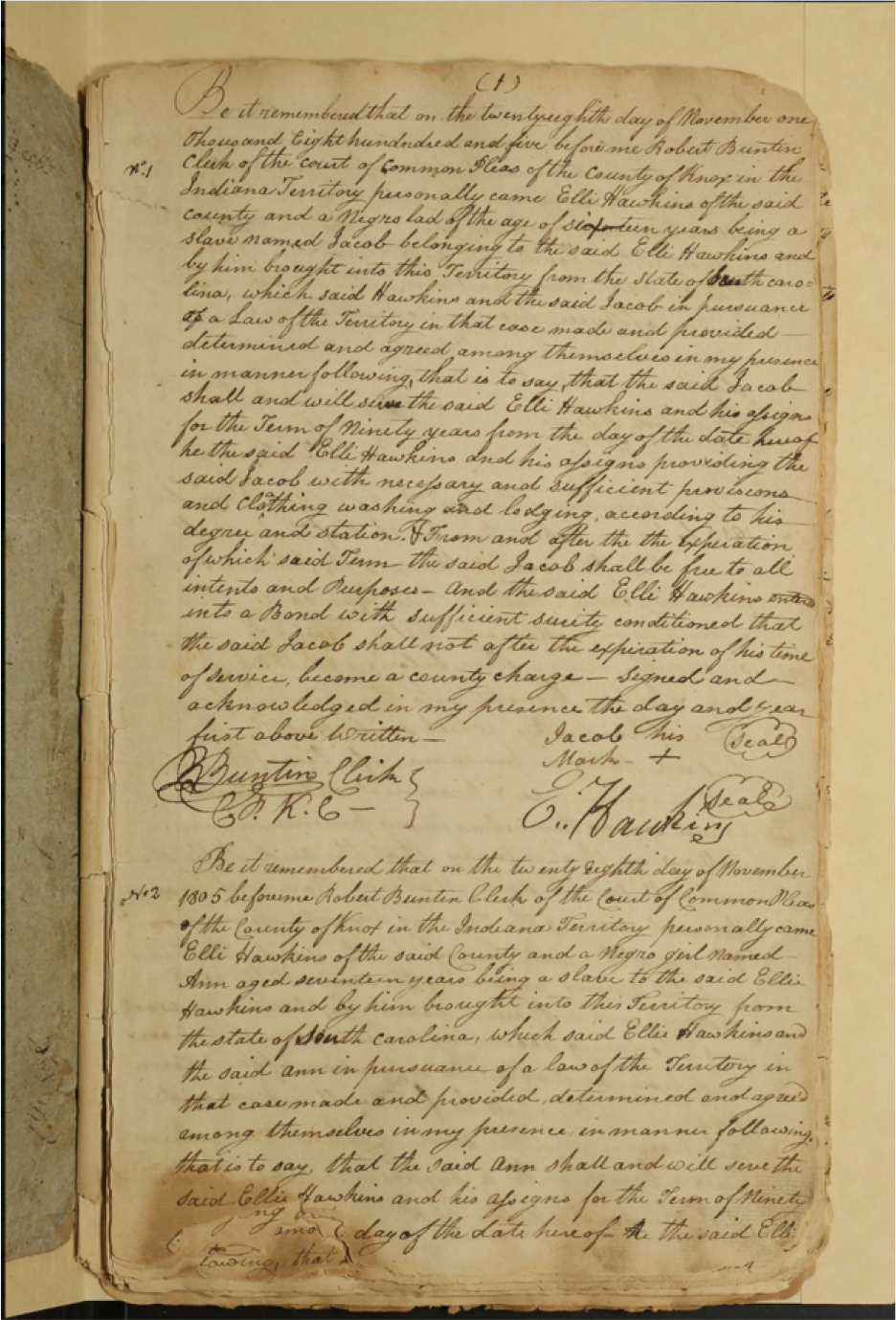
Slave Registry, Indiana Territory, Knox County, 1805-1807, p. 1, McGrady-Brockman House.
Source: Indiana’s Earliest Slave Register: Indiana Territory, Knox County, 1805-1807
Violence Under the Veneer of Law
The period between 1816 and 1851 wasn’t a picnic. We didn’t all sit down together and sing each other’s praises. The violence, the rhetoric. It was allowed to grow, and flourish. The law was weaponized to enforce racial caste systems. If the 1816 Constitution provided the blueprint, the following decades provided the enforcement.
The 1831 Bond Law: This was a transparent attempt to criminalize Black existence in Indiana. Under this law, any Black person entering the state was required to register with their local county clerk and post a $500 bond - an impossible financial burden for most - to guarantee "good behavior".
Vulnerability to Capture: Despite Indiana’s legal status as a "free" state, Black residents lived under the constant, terrifying threat of kidnapping. Slave catchers frequently traversed the state, often operating with the tacit - and sometimes active - support of local authorities to abduct free Black citizens and drag them into chattel slavery in the South.
The Failure of Protection: Because Black residents were prohibited from testifying in court against white citizens, they were stripped of the most fundamental tool for legal self-defense. This created a climate where violence - including physical assault and property theft - could be perpetrated against them with total impunity.
This was the rot hidden beneath the state's veneer. By the time the 1851 Constitutional Convention arrived, the state did not have to invent a new system of oppression; it simply had to codify the hostile reality that had been maintained through fear and legislation for the previous three decades.
Historical Hatred: 1851 Constitutional Convention
By 1851, the decay beneath the veneer no longer just operated in the shadows. It was moving through the state’s legal identity. Like a serpent it had coiled itself around the very core of the state. The Constitutional Convention of that year did not simply ignore the rights of Black Hoosiers - it actively sought to legislate their erasure.
Article XIII: The Absolute Exclusion: The convention delegates drafted Article XIII, a provision explicitly prohibiting any "negro or mulatto" from settling in the state after the constitution's adoption.
The Criminalization of Sympathy: To ensure total compliance, the 1851 Constitution went further than previous laws by voiding all contracts made with Black individuals and imposing severe fines on any white citizen who dared to conduct business with, or encourage the settlement of, Black individuals within the state.
From Custom to Constitution: What had been a loose web of local "bond laws" and terror-based enforcement for the previous three decades was now the supreme law of the land. This move essentially turned Indiana’s "Free State" promise into a closed border policy, demonstrating that the state's leadership had fully abandoned any pretense of equality in favor of rigid, state-sponsored exclusion.
A Legacy of Institutionalized Hostility
By codifying exclusion in 1851, Indiana did more than just pass a law; it established a cultural mandate that justified extrajudicial violence and systemic oppression for generations. What I would call the “bones” of the beast. The rot was now the law of the land, providing a legal framework for white supremacy that would eventually metastasize into the widespread atrocities of the 1920s.
The Normalization of Terror: With Black citizens legally dehumanized and stripped of basic protections, the state fostered an environment where white residents felt empowered to enforce racial hierarchy through intimidation and, frequently, lethal force.
A Culture of Impunity: The inability of Black residents to testify against white citizens - a practice embedded in the legal culture since early statehood - meant that acts of racial violence were rarely, if ever, prosecuted.
The Prelude to 1925: As we move toward the turn of the century and the approach of the Great War, this long-standing disregard for Black life created a vacuum where extremist groups could organize and operate with near-total protection from the very authorities sworn to uphold the law.
This period of "peace" was a facade; beneath it, the state was being groomed for the horrors it would visit upon its own citizens in the 1920s. The violence that would erupt after the Great War was not an anomaly - it was the inevitable harvest of the seeds planted in 1816 and aggressively fertilized in 1851.
The Rise of the Sundown Town
The legal architecture of 1851 provided the perfect cover for the rise of "sundown towns” - communities that systematically excluded Black residents through a combination of local ordinances, intimidation, and collective white violence. These were not accidental social patterns; they were deliberate, enforced spaces designed to maintain the "Free State" veneer by ensuring Black Hoosiers remained visible only as transient labor, never as neighbors.
Enforcement through Intimidation: Enforcement was rarely left to the law alone; it was a community-wide effort. If a Black person was found within city limits after dark, they were often met with harassment, physical assault, or threats of lynching to ensure their immediate departure.
The Role of Civic Complicity: Local authorities, including police and town officials, frequently acted as the primary enforcers, using the threat of "vagrancy" arrests to coerce Black residents out of town before sunset.
The Psychological Wall: By the time the Great War began, these practices had created a clear, albeit invisible, map of the state. Black residents knew exactly which towns were "sundown" and therefore lethal to occupy after dark, effectively ghettoizing the Black population into specific, confined areas.
This was the "muscle and sinew" of the beast - a system that didn't just rely on the state constitution to exclude, but empowered every white citizen to act as a deputized guard at the town limits. This culture of localized, constant enforcement was the bridge that led directly to the explosion of racial violence we see in the 1920s.
The Roaring 1920s: A Culture of Hate
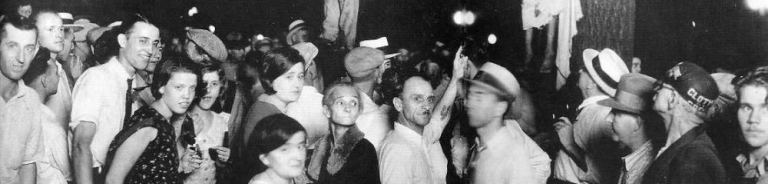
A crowd at the Marion courthouse looks on following the lynching of Shipp and Smith, courtesy of the Organization of American Historians.
By the time the 1920s arrived, the machinery of exclusion - built on the 1816 bias, hardened by the 1851 constitution, and maintained by the terror of sundown towns - had created a state primed for catastrophe. The rot was no longer just systemic; it had become a public, emboldened force.
The Mask Falls Away: The 1920s saw the KKK rise to unprecedented power in Indiana, effectively becoming the state’s shadow government. They did not have to invent their platform of hate; they simply utilized the existing culture of exclusion that had been nurtured for over a century.
The Atrocity of 1925: The horrors visited upon Indiana in the 1920s culminated in events like the 1925 atrocity - a brutal manifestation of the intolerance that had been state policy for generations. This was the inevitable result of a system that taught its citizens that their neighbors were "perpetual outsiders".
A State Unmasked: This decade revealed the ugly truth that the "Free State" label was nothing more than a veneer. The violence of this era was not an aberration, but the final, violent flowering of the seeds planted long ago in the Indiana Territory.
Separating the Chaff from the Wheat
The festering that began in the 1800s didn't just stay in the law books; it reached its lethal peak during the 1920s and 30s. The lynching photograph above is not just an image; it is the physical evidence of a state that had effectively sanctioned terror.
Public Terror as Enforcement: The act of lynching was not meant to be hidden; it was designed to be public, serving as a brutal, final warning to any Black resident who dared to challenge the state's racial hierarchy.
The Power of the Camera: By documenting these acts, even those who participated in the violence believed their actions were justified or even celebratory, unaware that these images would eventually become the permanent, damning indictment of Indiana's history that we are now using to dismantle their narrative.
From Law to Lethal Force: The transition from the legal exclusion of the 1851 Constitution to the extralegal violence of the 1920s and 30s was seamless, proving that when the law fails to protect its most vulnerable citizens, violence quickly replaces it as the primary tool of control.
Stubborn Hoosiers
Don't let anyone tell you this was a clean break. When the Feds finally started forcing the issue, Indiana didn't just fold; it dug in. The "sundown" reality didn't magically evaporate just because the laws on the books changed. Instead, the violence just got quieter, and the boundaries stayed exactly where they were.
The Federal Illusion: Even after the government stepped in, the threats didn't stop. They just shifted from the courthouse steps to the neighborhoods, where the message stayed the same: you aren't welcome here after dark.
The 90s and 2000s Hangover: This isn't just dusty history. I still carry the memories of how this played out in the 90s and 2000s, where the same old exclusionary energy was very much alive and well.
No Real Growth: If you think we've truly moved past this, you aren't looking closely enough. The stubbornness that built these towns is still here, and the progress we claim to have made is a lot thinner than people want to admit.
The systems were designed to last, and it's clear we haven't grown nearly as much as we pretend. We're still living in the shadow of what they built.
Even all this time after the Civil Rights movement, we still fight the ghosts of our violent past. Many Hoosiers are working every day to change the narrative. Bring truth to light, and help us all work to heal the wounds inflicted. There will always be the scars of our past. However, none of us are free, until all of us are free.
References & Sources
Knox County Slave Register: Knox County Slave Register, Eli Hawkins registers Jacob, 1805. Indiana Memory. https://indianamemory.contentdm.oclc.org/digital/collection/kcpl/id/43491/
Constitution of the State of Indiana (1851): Constitution of the State of Indiana, 1851. Indiana Archives and Records Administration. https://www.in.gov/history/about-indiana-history-and-trivia/explore-indiana-history-by-topic/indiana-documents-leading-to-statehood/constitution-of-1851/
The Lynching of Thomas Shipp and Abram Smith: Strange Fruit: The 1930 Marion Lynching and the Woman Who Tried to Prevent It. The Indiana History Blog (Indiana Archives and Records Administration). https://blog.history.in.gov/strange-fruit-the-1930-marion-lynching-and-the-woman-who-tried-to-prevent-it/
Sundown Towns: James W. Loewen, Sundown Towns: A Hidden Dimension of American Racism. Zinn Education Project. https://www.zinnedproject.org/materials/sundown-towns/
