The Crossroads of History: Having a Blast Along the Wabash River
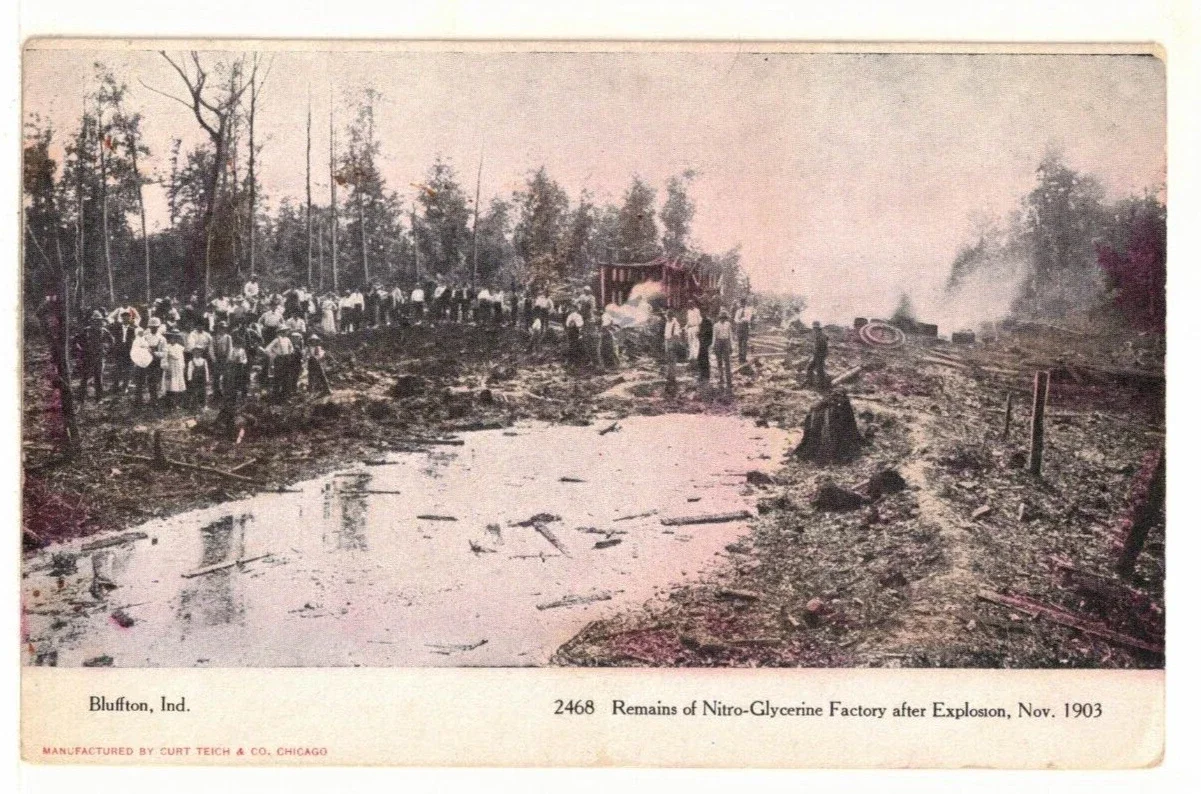
Postcard from Bluffton Indiana
“2468 Remains of Nitro-Glycerine Factory after Explosion, Nov. 1903” The scene depicts a large crater filled with water, destroyed timber, and leveled forest remains. Around the crater a group of men are gathered.
The Wabash River valley in Wells County is a landscape of deceptive calm. Today, the stretch of land three miles northeast of Bluffton is defined by the gentle topography of rolling farm fields and the quiet rustle of corn stalks under the Indiana sky. But if you know where to look - if you know how to read the scars of the earth - the silence is interrupted. There is a pond, perfectly round and unnaturally still, sitting in the middle of a private field. It is not a natural feature; it is a crater, a memory of a Tuesday morning in August 1903 that never truly went away.
On August 5, 1903, the Empire-American Nitroglycerin Company was busy fueling the insatiable hunger of the oil boom. The industry required "nitro" - volatile, unpredictable, and lethal - to fracture the limestone beds deep beneath the surface and force the crude to the top. It was dangerous work, and it was performed by men who knew they were playing a game of Russian roulette with every mile they traveled.
Edward Radabaugh, William Howard, and William Steffy were the men on the clock that morning. They were the "shooters," the laborers whose names appear in the archives only as casualties of the "cost of doing business." Their work was simple, terrifying, and essential: move the explosive, load the wells, repeat.
At the center of their operation was a work mule. In the folklore of the Wabash Valley, the mule is often dismissed as mere set-dressing for a grim industrial tale, but in truth, it was the connective tissue of the entire operation. It pulled the wagon; it navigated the rutted dirt roads; it stood patiently while unstable cans of liquid catastrophe were jostled and shifted. The mule did not understand the volatility of its cargo, nor did it have the agency to refuse the journey. It was the ultimate, silent laborer - a creature entirely at the mercy of the men holding the reins and the corporate entity that prioritized the flow of oil over the integrity of the ground.
Then came the drop. A single moment of human fallibility - a slip of the hand, a rusted hinge, a sudden jolt - and the world ended.
Two thousand quarts of nitroglycerin do not merely "explode." They undergo a violent, instantaneous conversion into pure, concussive energy. When the Empire-American site detonated, it didn't just kill the three men and the mule; it effectively erased the site of their existence. The force was so immense, so absolute, that it reshaped the earth, creating the pond that persists as a watery grave today.
But the most haunting evidence of that day lies in the stories told by the farmers and the laborers who worked the fields for miles around. In the days following the blast, they went looking for the wreckage. They expected to find pieces of the wagon, or parts of the factory structure. Instead, they found fragments of the mule. The accounts, passed down through oral tradition and solidified in the local mythology of Wells County, claim that remnants of the animal were discovered nearly 50 miles away.
Whether this distance is a precise measurement or a hyperbolic expression of a community’s collective shock, the message is clear: the violence was uncontained. It was a physical dismemberment of the workforce, a scatter of life across the county that defied the boundaries of the "factory" site. When we talk about the history of industrialization, we often focus on the output - the barrels of oil, the growth of the towns, the prosperity of the state. We rarely look at the debris field. We rarely account for the physical reality of what it meant to be a disposable resource in 1903.
For my work at The Archives, this crater is not just a pond. It is a monument to the forgotten. It represents the rotten core of our history - a timeline of industrial and societal tension that stretches from 1890 to 1969, where the value of a life was often calculated in fractions against the value of a barrel of crude. The mule, scattered across the horizon, is the most potent symbol of this: a worker who, in a single, silent instant, became part of the very soil it helped to exploit.
When you walk past that pond today, you are walking over a site of intense, industrial agony. You are walking over the dust of a mule that, by every measure of modern decency, deserved better than to be an atomized component of a production schedule. We have been conditioned to view this as an "accident" - a tragic, isolated event in the rough-and-tumble history of the oil fields. But by treating it as an isolated incident, we help the algorithm erase the truth: that this was the systemic reality of an era that built Indiana’s prosperity on a foundation of expendable flesh.
The postcard of the "Remains of the Nitro-Glycerin Factory" sits in my collection, a yellowing piece of paper that captures the stillness after the chaos. It shows the shattered timber and the hollowed-out earth. It is a crime scene photo that the public has spent over a century viewing as a curiosity.
It is time to look closer. It is time to recognize the scars in the fields for what they are. Every time we ignore the "mule in the field," we validate the same systems that keep the truth buried under a quiet, stagnant pond. We are not just reclaiming history; we are reclaiming the victims from the indifference of time. The Wabash remembers, even if the maps do not. And as long as I have a voice, the silence of that field will not be the end of the story.
Primary Sources & Artifacts
Syndicated Wire Report: "Empire-American Nitroglycerin Company's Magazine." Syndicated news brief (dateline Bluffton, Ind.), published August 14, 1903. Pine City Area History Association Archives.
Relevance: This is the primary syndicated text that circulated nationally, confirming the August 1903 date, the ignition source (dropped can), the 2,000-quart volume, and the names of the victims: William Howard, Edward Radabaugh, and William Steffy.
Photographic Evidence: Remains of Nitro-Glycerine Factory After Explosion — Nov. 1903 — Bluffton, Indiana. [Vintage Undivided Back Postcard]. Bluffton, IN, 1903.
Relevance: The visual documentation of the crater site, serving as the physical proof of the disaster's scale and the immediate commodification of the tragedy for public consumption.
Regional Industrial Context
Indiana Gas and Oil Boom History: Flook, Chris. "Muncie's Nitroglycerin Safecrackers of 1905." Society Blog, Delaware County Historical Society.
Relevance: Provides the broader operational context of the Empire-American Glycerine Company, the strategic isolation of their magazines, and the sheer instability of nitro transport during the state's extraction boom.
Regional Labor Casualties: Steiner, Fred. "If You Thought DDT Was Dangerous..." Bluffton Forever Historical Archives.
Relevance: Chronicles how local and regional newspapers of the era routinely documented the grim reality of "shooters" and their transport animals being obliterated, establishing that these explosions were a systemic hazard rather than isolated anomalies.
