Sundown Towns: A Dark History
Indiana wasn’t so exclusionary at it’s birth. However, in 1851, some very naughty politicians decided to add Article 13 when they were writing me. Today that stands as a great shame we can never really erase. Even if it was removed in 1881.
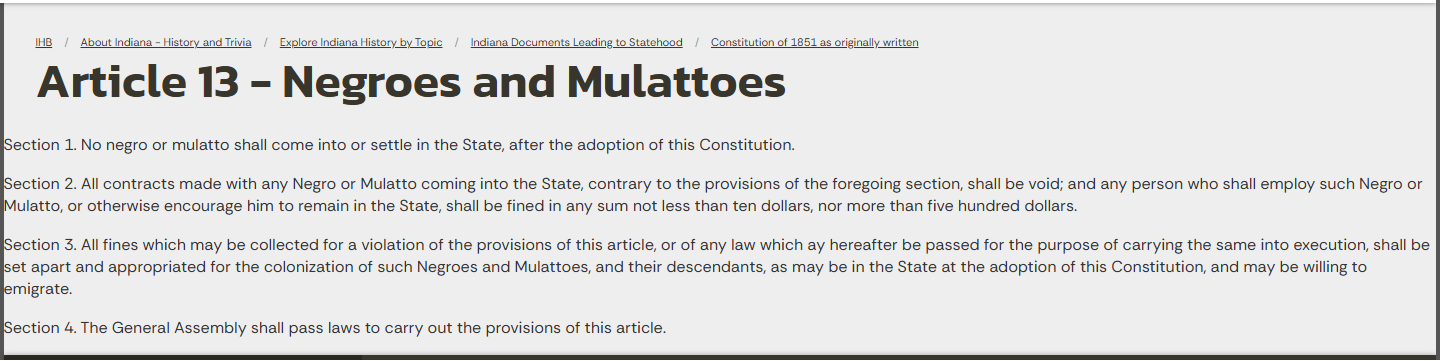
Article 13 of the 1851 Indiana Constitution which was repealed in 1881. Courtesy: https://www.in.gov/history/about-indiana-history-and-trivia/explore-indiana-history-by-topic/indiana-documents-leading-to-statehood/constitution-of-1851/article-13-negroes-and-mulattoes/
This Didn’t Lead to Anything Good
When you look at the tensions leading up to 1851, you aren't just looking at political disagreement; you are looking at a state that was suffering from an identity crisis, and which chose to resolve that crisis by slamming the door on Black humanity. By 1850, the 1816 Constitution—which was relatively progressive for its time regarding the prohibition of slavery - was viewed by many Hoosiers as a "dead" document. It was seen as inefficient, permissive of local "special" legislation that favored political cronyism, and increasingly unable to govern a state that had grown from a frontier territory into a complex, agricultural, and proto-industrial society.
But the real "ghost" of the 1851 Convention wasn't just administrative efficiency - it was the anxiety over the status of Black people in the state.
Article 13 was the culmination of decades of increasingly repressive legislation. Before 1851, the state had already denied Black residents the right to vote, the right to serve in the militia, the right to attend public schools, and even the right to testify in court against a white person.
Article 13 was the final, brutal tightening of that noose. Its first section explicitly stated:
"No negro or mulatto shall come into, or settle in the State, after the adoption of this Constitution."
It wasn't just a law; it was an attempt to turn Indiana into a whites-only sanctuary. The sheer irony is palpable: Indiana, a state that had been part of the Northwest Territory (which theoretically prohibited slavery), was using its "sovereign" power to effectively ban the presence of Black people entirely. The 1851 Indiana Constitution was not merely a administrative document; it was a reactionary statement of identity. By codifying this prohibition, the state government signaled to every township, county, and municipal jurisdiction that racial homogeneity was the desired - and legally sanctioned - norm.
This created a "climate of permission" that lasted long after the article itself was rendered unenforceable by the 14th Amendment and subsequent federal rulings. The legal language may have been struck, but the precedent remained that a community’s right to "police its own borders" was paramount.
From Law to "Custom": The Rise of Sundown Towns
The jump from a state-wide ban to the widespread adoption of sundown policies in the late 19th and early 20th centuries occurred through the following mechanisms:
The Normalization of Exclusion: Because Article 13 had established that Black residency was fundamentally "obnoxious" to the state, the legal burden of proof shifted. When local residents engaged in "whitecap" violence, intimidation, or social ostracization to drive non-whites out, they were not viewed by many as breaking the law, but as "maintaining the standard" established by the 1851 framework.
The 1890–1969 "Red Summer" Continuum: As the political climate shifted toward the Jim Crow era, Indiana saw a surge in the deliberate, coordinated expulsion of Black residents. Towns that had once had small Black populations saw them erased through targeted police harassment, property arson, and threats of mass violence. This period solidified the "sundown" status for hundreds of municipalities across the state.
The Shift to Administrative Exclusion: As federal scrutiny grew in the mid-20th century, the mechanisms of exclusion evolved from overt violence to administrative and environmental gating. This involved:
Real Estate Redlining: Utilizing discriminatory lending and appraisal practices to prevent non-whites from purchasing property, effectively codifying "all-white" zones.
Zoning as a Tool of Segregation: Communities used industrial zoning and "public safety" justifications to create physical barriers around areas designated for exclusionary development, ensuring that demographic shifts could be controlled or prevented entirely.
Pretextual Policing: The emergence of "broken windows" policing in small towns often served the same function as the old "sunset" signs, using constant surveillance and frequent traffic stops to signal to non-residents that they were under constant threat of arrest.
The Legacy of the "Original Sin"
The proliferation of these towns was not an anomaly; it was the inevitable result of a foundational document that viewed the state as a closed system. The "ghosts" in these municipalities are the direct consequence of decades spent refining the art of keeping the town "pure."
By establishing at the outset that the state was not for everyone, the 1851 Constitution empowered generations of local authorities to treat their town borders as private property, leading to the complex, deeply rooted, and often invisible patterns of segregation that persist today.
The Paradigm Shift
The passage of the Fair Housing Act (Title VIII of the Civil Rights Act of 1968) marked a profound legal pivot, but in the context of Indiana’s history, it represents a transition from overt exclusion to institutional endurance. While the Act made explicit racial discrimination in housing illegal, it did not - and could not - instantly dissolve the deep-seated structural and cultural mechanisms that had been refining exclusion for over a century.
The Immediate Legal Shift
Before 1968, the mechanisms of the "sundown" era were often supported by the state’s legal architecture. After the Fair Housing Act, the overt tools - such as "whites only" real estate covenants, town ordinances banning Black residency, and explicit "sundown" signage - became federally illegal.
However, the Act’s impact was limited in three significant ways:
The "Class" Loophole: The Fair Housing Act prohibited discrimination based on race, color, national origin, religion, sex, disability, and familial status. It did not, however, prohibit discrimination based on economic status. This created an opening for "exclusionary zoning" (or "snob zoning") to fill the void. Municipalities found they could achieve the same demographic results by mandating high minimum lot sizes, restrictive square-footage requirements, or bans on multi-family housing, effectively pricing out those who were previously barred by race.
The Persistence of De Facto Segregation: Because the Act relied on enforcement and individual litigation, many communities remained "all-white on purpose" for decades after 1968. If a town had successfully driven out its Black population by the 1920s or 1930s, the passage of the Fair Housing Act didn't automatically bring them back. The absence of a Black population meant there were no residents to "test" the new law, allowing discriminatory local customs - like biased policing or informal "gentlemen’s agreements" among realtors - to persist unchallenged.
The Geography of Exclusion: The Act did little to undo the physical and economic scars left by decades of redlining and urban renewal. Neighborhoods that had been "redlined" by the Federal Housing Administration (FHA) throughout the mid-20th century were locked out of capital investment. Even after the law changed, these areas suffered from chronic under-investment, while suburban "whites-only" enclaves continued to flourish, benefiting from decades of subsidized homeownership that had been denied to others.
The Shift to "Second-Generation" Sundown Status
Historians of the sundown phenomenon note that many towns transitioned into "second-generation" status. These are communities where the law officially says "all are welcome," but the culture remains exclusionary.
Policing as Perimeter Control: In the absence of "sundown" signs, the role of enforcing the boundary often shifted to local law enforcement. Practices like "driving while Black" became the modern surrogate for the old exclusionary ordinances, serving as a warning that certain towns were still not intended to be inclusive spaces.
The Administrative Barrier: The "fence" moved from the city limits to the permit office. By weaponizing zoning, nuisance ordinances, and code enforcement, towns could maintain a "closed" status that was technically compliant with federal fair housing standards but functionally exclusionary.
The "Invisible" Legacy: Today, the lingering effects of these policies are visible in the stark racial and economic disparities in homeownership, property wealth, and access to resources. The Fair Housing Act dismantled the legal walls, but the foundational ones - the ones embedded in the bedrock of property values, school districts, and municipal zoning - proved much harder to move.
In short, the Fair Housing Act was a success in ending the era of the sign, but it was only the beginning of a much longer, more difficult struggle to end the era of the system. The challenge that remains is that the "haunting" of these towns is not just a matter of memory; it is a matter of the current, built environment that continues to prioritize the exclusion of the past.
Those Still Seeking Redemption
The transition of communities from a legacy of deliberate exclusion to an active pursuit of modernization and inclusion highlights a critical friction point in municipal history. In places like Bluffton, Indiana, the effort to dismantle the unwritten codes of the sundown era requires moving past generations of institutional silence to consciously re-engineer the town’s public image and civic identity.
Shifting the Civic Facade: The Power of Visible Rebranding
For towns with deep-rooted exclusionary reputations, the first step in changing public perception often begins with the literal signage and branding that marks their borders. In historical sundown towns, entering the municipal boundary was once a point of explicit hazard for minorities. To reverse this, several communities launched visible civic campaigns aimed at broadcasting a deliberate shift in values:
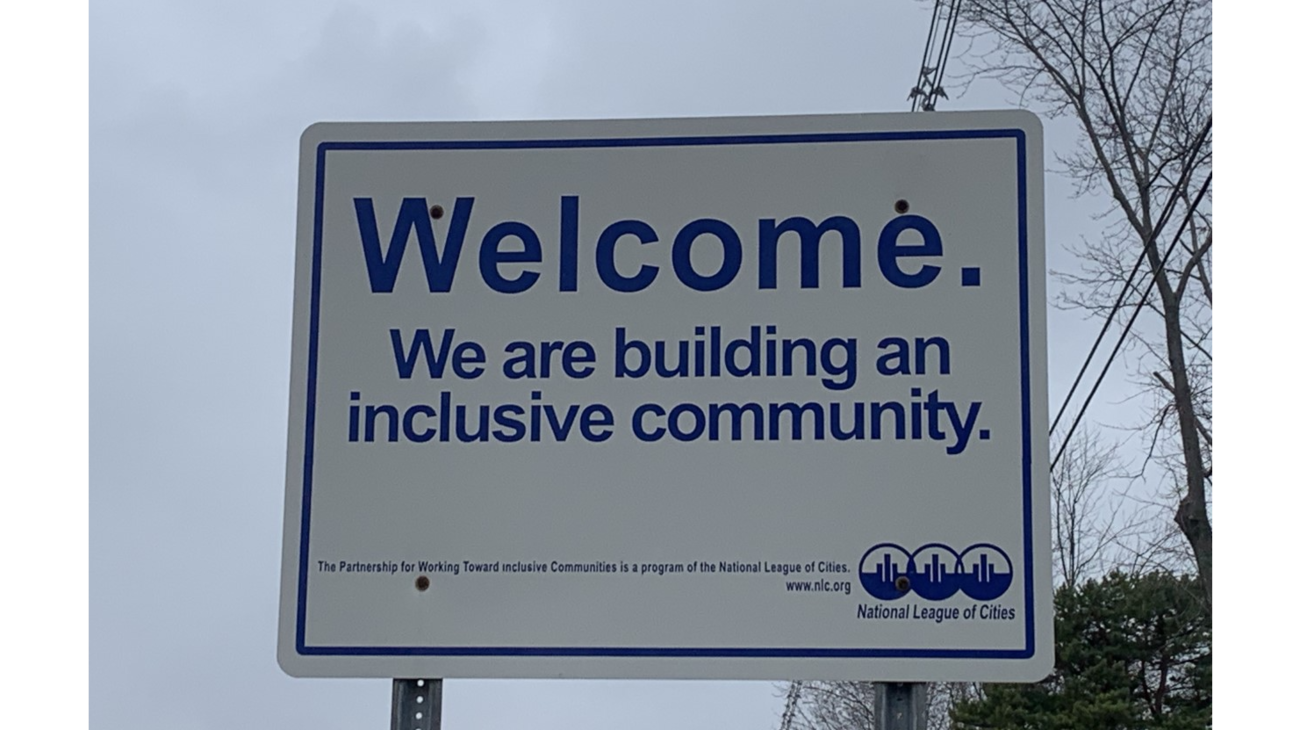
Inclusive Community Sign on the Outskirts of Bluffton, Indiana
Bluffton Mayor John Wicker says that the city is not taking down the inclusive welcoming signs and wanted to set the record straight. He says he is angry with the social media posts that he says put Bluffton in a bad light. (circa Jan. 5, 2023)
Inclusive Highroad Signage: Rather than relying on standard municipal welcome signs, communities began erecting highway and entrance markers specifically emphasizing inclusion, community unity, and civic warmth. For instance, in the mid-2000s, Bluffton received regional and national attention for implementing public welcome signs at city entrances and outside local schools that explicitly communicated a message of safety, hospitality, and shared belonging for all residents and visitors.
The Wikipedia and Public Record Corrections: The battle over a town's reputation also plays out significantly in digital spaces. Many local leadership groups, historians, and progressive citizens have opted to confront historical transparency directly rather than suppressing it. Municipal summaries and public platforms have increasingly been edited to openly acknowledge the county’s past restrictive practices, utilizing that history as a explicit baseline to measure modern diversity initiatives.
Dismantling "Custom" Through Administrative Transparency
As historical analysis of Indiana’s race relations shows, discrimination was frequently sustained not by formal law, but by unwritten "customs" that dictated who belonged after dark. Changing that reality requires replacing informal biases with formalized administrative accountability:
Countering Pretextual Surveillance: One of the most persistent remnants of sundown culture has been the phenomenon of biased traffic enforcement or "Pretextual Policing" near town borders. Modern reform efforts in small municipalities involve updating police department guidelines, implementing implicit bias training, and increasing data transparency surrounding traffic stops. By explicitly tracking and auditing enforcement patterns, cities attempt to assure surrounding regional populations - such as commuters from larger, more diverse adjacent hubs like Fort Wayne - that the historic "border patrol" mentality is actively being phased out.
Active Regional and Economic Integration: True structural change requires breaking down isolationist economic practices. Communities looking to shed a sundown legacy are increasingly engaging with regional coalitions, diversifying local Chamber of Commerce initiatives, and actively marketing municipal job growth to a broader demographic footprint. The goal is to shift the local economy from a closed, legacy-dependent ecosystem into an open, collaborative participant in the statewide market.
The Friction of the Progress Narrative
While public relations campaigns and inclusivity markers are vital steps toward civic rehabilitation, the process of changing a town's historical trajectory creates an ongoing internal dialogue. The fundamental challenge lies in ensuring that the visible markers of an "inclusive future" do not serve as a new, modernized layer of erasure over the underlying historical landscape.
For a community working to fix its systemic issues, the transition is slow and deliberate. It involves a continuous effort to prove that the new signs at the edge of town are not just decorative shields, but genuine reflections of a structural commitment to ensuring the past is neither repeated nor ignored.
For More Information Click HERE to visit the Sundown Town map and relevant history that has been recorded.
References
Etcheson, N. (2013). Repudiating the Administration: The Copperheads in Putnam County, Indiana. Ohio Valley History, 13(3), 47–67. https://muse.jhu.edu/article/571672/summary
Galster, G. C. (2019). The Evolving Challenges of Fair Housing Since 1968. Cityscape: A Journal of Policy Development and Research, 21(1), 3–14. https://www.huduser.gov/portal/periodicals/cityscpe/vol21num1/Cityscape-March_2019.pdf
Loewen, J. W. (2005). Sundown Towns: A Hidden Dimension of American Racism. The New Press. https://search.proquest.com/openview/4c0b1a9c5b1c46c13284a5851d7c28ea/1?pq-origsite=gscholar&cbl=46710
Hswen, Y., Yang, F., Le-Compte, C., Hurley, M. E., Mattie, H., & Nguyen, T. T. (2023). Structural racism through Sundown towns and its relationship to COVID-19 local risk and racial and ethnic diversity. Preventive Medicine Reports, 35, 102260. https://www.researchgate.net/publication/371027292_Structural_Racism_through_Sundown_Towns_and_its_relationship_to_COVID-19_local_risk_and_diversity
Massey, D. S. (2015). The Legacy of the 1968 Fair Housing Act. Sociological Forum, 30(S1), 571–588. https://collaborate.princeton.edu/en/publications/the-legacy-of-the-1968-fair-housing-act/
Nielsen, L. E. (2006). A Review by Lynn E. Nielsen of Sundown Towns: A Hidden Dimension of American Racism, by James Loewen. UNIversitas: Journal of Research, Scholarship, and Creative Activity, 2(1), Article 6. https://scholarworks.uni.edu/universitas/vol2/iss1/6/
O’Connell, H. A. (2018). Historical Shadows: The Links between Sundown Towns and Contemporary Black–White Inequality. Sociology of Race and Ethnicity, 5(3), 311–325. https://www.asanet.org/wp-content/uploads/attach/journals/jul19srefeature.pdf
Ortiz, J., Dick, M., & Rankin, S. (2015). The Wrong Side of History: A Comparison of Modern and Historical Criminalization Laws. Seattle University School of Law, Homeless Rights Advocacy Project. https://digitalcommons.law.seattleu.edu/cgi/viewcontent.cgi?article=1003&context=hrap
