Indiana’s Underground Railroad
The Ohio River was a thick thread of liquid night under the midnight horizon, but to the thousands who stared across it from the banks of Kentucky, it was a proverbial Jordan. Crossing it was like stepping from the explicit horror of the human bondage into a fragile, precarious version of freedom.
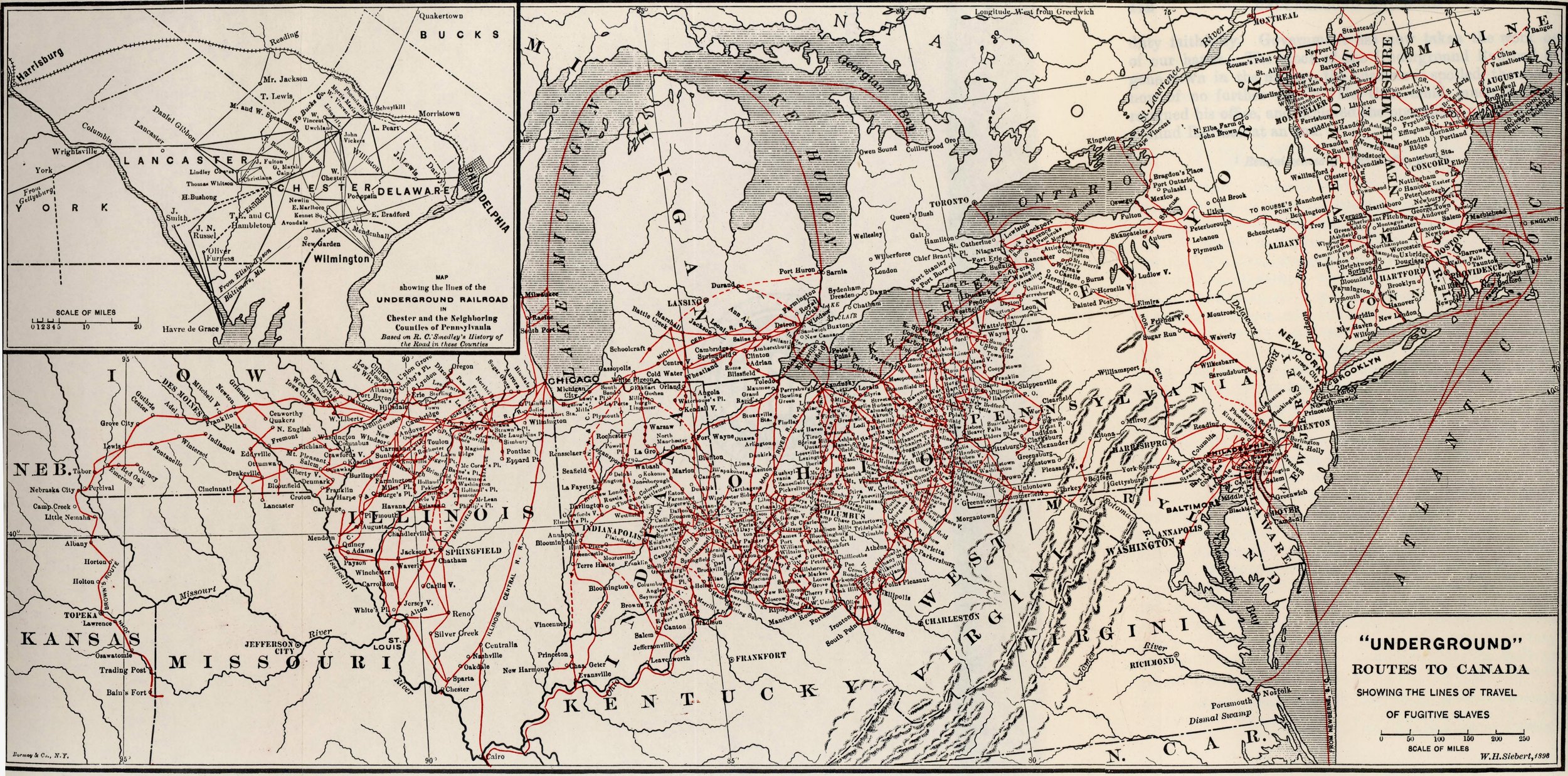
By https://lccn.loc.gov/68003375Siebert, Wilbur Henry, 1866-1961. The underground railroad from slavery to freedom. With an introd. by Albert Bushnell Hart. Gloucester, Mass., P. Smith, 1968 [c1898] xxvi, 478 p. illus., facsim., fold. map, ports. 21 cm. E450 .S57 1968 - http://history.sandiego.edu/gen/CWPics/86139.jpg. Compiled from "The Underground Railroad from Slavery to Freedom" by Wilbur H. Siebert, The Macmillan Company, 1898.[1], Public Domain, https://commons.wikimedia.org/w/index.php?curid=405624
Many Came Here First
For so many who made that often treacherous crossing, their first steps into that precious freedom began on Indiana soil.
Popular memory often paints the Underground Railroad as a unified, romanticized network of secret tunnels and benevolent white abolitionists. Unfortunately the reality in Indiana was far more dangerous, deeply fractured, and profoundly somber. Seeking freedom in the Hoosier State was not to find immediate safety, it was to enter a legal and social minefield where the state government itself had codified your exclusion into law.
Crossing the Jordan: The Reality of the Indiana Banks
To pull a boat onto the northern banks of the Ohio River or to pull oneself shivering from its currents was to achieve a monumental victory, but the relief was instantly met with a cold stark reality. As you can see in the image above, with it’s sprawling network of red veins on the historical map, the paths were numerous, but the immediate shoreline was heavily patrolled and deeply compromised.
Freedom seekers making landfall in river towns like Evansville, New Albany, or Madison did not find a welcoming committee. No, instead, they were greeted by a frontier under constant surveillance.
The Geography of Danger
The geography of southern Indiana created an immediate psychological and physical trial for those who had just crossed:
The Lookouts and Bounty Hunters: Because the Ohio River was the literal dividing line between a slave state and a free territory, professional slave catchers and local opportunists constantly staked out common landing spots. A single misstep on the riverbank could mean instant capture and a violent return to Kentucky.
The Sympathetic Pockets vs. Hostile Majorities: Towns right on the water were deeply divided. While courageous abolitionists lived within these communities, many river-town economies were tightly bound to commerce with the South. Stepping into the wrong tavern or asking the wrong dockworker for directions was an existential threat.
The Midnight Gauntlet: Most crossings happened under total darkness. Once on the Indiana side, freedom seekers had to quickly navigate rugged, unfamiliar bluffs and thick forests without lanterns, moving entirely on instinct and the whispered instructions given to them by operators on the Kentucky side.
The First Safe Havens
Those who managed to make it past the initial traps on the shore, found the first line of defense was strategically positioned border stations.
In Madison, the steep hills rising from the river led up to Lancaster, where the Eleutherian College community stood as an integrated beacon of resistance. In Floyd County, freedom seekers looked for specific code signals, a candle in a specific window, or a particular arrangement of laundry on a line. All guiding them to safe houses operated by free Black residents and sympathetic white families just miles from the water.
Reaching the bank was only the beginning. The real test of the Indiana network began the moment their feet touched the northern mud. Where they then had to turn their attention to the 300-mile journey through a state that, by law, did not want them there.
The Railway in the Shadows: Signals, Safehouses, and Traps
If making it past the riverbanks was a feat of sheer adrenaline, navigating the interior of Indiana was a grueling game of chess against a grandmaster. Freedom seekers had to push north along the routes we seen in the image above, they moved out of the immediate border zone and into a vast, rural landscape where the network had to operate with absolute secrecy.
The “railroad” in Indiana was not a fixed path; it was a shifting labyrinth of safehouses, coded language, and constant improvisation designed to outsmart a highly motivated enemy.
Coded Words and Invisible Signals
Because a single slip-of-the-tongue could lead to prison or death, conductors relied on an intricate system of signs and symbols to pass people along:
The Language of Commerce: Underground operators adopted railroad terminology as a spoken cipher. Freedom seekers were "passengers" or "baggage." Safehouses were "stations," and those who guided them between stops were "conductors."
Visual Cues: A quilt hung over a porch railing with a specific pattern, a lantern placed in a precise window pane, or a distinct hitching post arrangement signaled whether a station was safe or compromised.
The Midnight Knock: Movements happened almost exclusively between midnight and dawn. Conductors would arrive at a station, using specific, rhythmic knocks or animal calls to alert the stationmaster without waking neighboring farms.
The Traps Along the Way
Moving north did not mean the danger went away. In many ways, the traps became more sophisticated the further inland a freedom seeker traveled.
Professional Bounty Hunters: Spurred by the massive financial incentives reinforced by the Fugitive Slave Act of 1850, professional slave catchers patrolled major crossroads, tavern junctions, and train depots. They kept detailed descriptions of escapees and were legally authorized to deputize regular citizens on the spot.
Local Informants: In many Indiana counties, anti-abolitionist sentiment ran deep. Neighbors watched neighbors. A sudden increase in a family's grocery purchases, smoke rising from a barn chimney in the dead of summer, or unusual wagon movements at night could prompt an informant to alert the local sheriff.
The Legal Snare: If captured, freedom seekers faced a legal system heavily stacked against them. Federal commissioners were paid double to rule in favor of a slaveholder over a freedom seeker, making legal recourse within the state virtually impossible.
In order to evade these traps, passengers were often forced off the established roads entirely. They walked through malaria-ridden swamps, dense hardwood forests, and creek beds to mask their scent from tracking dogs. When they did travel by road, it was often hidden beneath false floors in farm wagons, covered in hay, or disguised in heavy clothing to pass as local laborers.
Every mile gained was a triumph of counter-intelligence, executed be everyday people who knew that a single mistake could spring the trap.
Those Brave Souls: The Guardians of the Gate
Those fragile lines of crimson shown in the map, were not self-sustaining; they were maintained by human courageousness. While hundreds of operators remain lost to time due to the necessary secrecy of their work, history has preserved the names of a few remarkable individuals who turned their homes, their wealth, and their very bodies into the the shield of the vulnerable.
Here are some of those brave people who anchored Indiana’s Underground Railroad:
Levi and Catharine Coffin Operating from their home in Newport (now Fountain City), this Quaker couple managed what was universally acknowledged as the "Grand Central Station" of the entire Midwest network. Levi, a shrewd merchant who strictly refused to sell goods produced by enslaved labor, used his business acumen to finance the movement, earning him the legendary title of "President" of the Underground Railroad. Catharine was the operational heartbeat of the home, organizing networks of women to sew clothing, preparing massive meals at a moment's notice, and altering their home's interior architecture to include hidden spaces behind brick walls. Together, they successfully funneled over 3,000 freedom seekers toward safety without a single soul being recaptured under their watch.
Chapman Harris A towering figure of resistance in Jeffersonville, Chapman Harris was a free Black man who operated one of the most daring and physically grueling stations right on the edge of the Ohio River. Standing over six feet tall and possessing immense physical strength, Harris worked as a teamster and a farmer, using his daily movements to scout slave catchers and coordinate with contacts on the Kentucky side. When a crossing was ready, Harris would signal across the dark water by striking a massive metal iron plate hung in a sycamore tree. He routinely risked his own freedom by rowing out into the dangerous river currents under the cover of night to personally pull freedom seekers from the southern shore, acting as the literal bridge between bondage and hope.
Dr. John W. Harrison A regular physician practicing in the fiercely divided border town of Madison, Dr. Harrison used his professional status as the perfect alibi for nighttime travel. While locals assumed he was out making late-night house calls to sick patients, Harrison was frequently using his horse and buggy to transport freedom seekers away from the highly patrolled riverfront and up into the hills of Jefferson County. His medical bag often carried food and supplies rather than medicine, and his deep knowledge of anatomy and disguise allowed him to coat the hands and faces of escapees with specialized chemical stains or cosmetics to help them pass undetected through daylight checkpoints.
William Trail While many are remembered as conductors, William Trail's legacy is that of a freedom seeker who stood his ground and forced Indiana to recognize his humanity. Having escaped enslavement in Maryland, Trail made his way to Henry County, Indiana, in the 1830s. When slave catchers tracked him down and attempted to drag him back south, Trail resisted both physically and legally. Supported by sympathetic neighbors, he took his fight to the courts, surviving multiple capture attempts and eventually establishing a thriving farm. His sheer resilience transformed his homestead into a psychological fortress and a literal sanctuary for other travelers moving along the eastern trunk lines.
John Todd and the Rev. Thomas Craven These men were the visionary driving forces behind Eleutherian College in Lancaster, a radical institution founded on the explicit principle that all people, regardless of race or gender, deserved equal education. Todd and Craven knew that true freedom required more than just physical escape; it required intellectual liberation. They designed the college to serve a double purpose: by day, it was an integrated school where Black and white students studied side by side; by night, its stone buildings and the surrounding rugged, wooded hills served as an unassailable station on the line moving north from Madison, protected by an entire community committed to racial equality.
The Ultimate Clash: The 1851 Constitution and the End of the Line
As the 1850s progressed, the invisible lines of the Underground Railroad, now only visible as history’s ghosts on maps like that at the top of this article. They met in a head-on collision with a wall of state-sanctioned hostility.
The political tension in Indiana reached a boiling point in 1851. When the delegates gathered to draft a new Indiana Constitution, their anxieties over a growing national crisis and the influx of free Black Americans culminated in a devastating legal blow. Under Article XIII of the 1851 Indiana Constitution, the state explicitly banned Black or mulatto individuals from migrating into or settling within Indiana’s borders. It also made any contract with an incoming Black resident null and void, and leveled severe fines against any citizen who employed or harbored them.
It wasn’t just a law passed by a distant legislature; it was a constitutional mandate ratified by a massive majority of Indiana voters.
The Choice Between Law and Conscience
For the conductors and stationmasters along the network, Article XIII changed the stakes entirely. Helping a freedom seeker was no longer just a violation of federal law via the Fugitive Slave Act; it was an act of explicit defiance against the foundational document of their own state.
However, in spite of that, the network tightened its resolve. The passage of the 1851 Constitution stripped away any illusion that Indiana could be a permanent home for those escaping bondage. It forced the Underground Railroad to change from a network of potential settlement into a high-speed transit system. Indiana was no longer a place to find a new life; it was a dangerous 300-mile gauntlet that had to be crossed as quickly as possible on the way to Michigan or Canada.
Operations became more secretive, the safehouses became heavily fortified, and the legal defense strategies more creative. Activists continued to move “baggage” in the dead of night, choosing to follow a higher moral law rather than comply with a compromised state constitution.
The Weight of the Tracks
The Underground Railroad in Indiana did not fade away until the outbreak of the Civil War permanently shattered the institution of slavery. When we look back at this chapter of our history, we are forced to confront a deeply sober truth: the heroes we celebrate today—the Coffins, the Harrisons, the Harrises, and the unnumbered free Black communities—were considered criminals by the state of Indiana at the time.
Their legacy is a reminder that the moral arc of our state didn't bend toward justice on its own. It was bent by ordinary citizens who looked at the legal landscape of 1851, looked at the human beings standing shivering on the banks of the Ohio River, and chose humanity over the law.
References
Blackett, R. J. M. (2014). The Underground Railroad and the struggle against slavery. History Workshop Journal, 78(1), 275–286.
Coffin, L. (1876). Reminiscences of Levi Coffin, the reputed president of the Underground Railroad. Sampson Low, Marston, Searle, & Rivington.
Gara, L. (1961). The Underground Railroad: Legend or reality? Proceedings of the American Philosophical Society, 105(3), 334–339.
Gibbs, W. L. (Ed.). (1993). Indiana's African-American heritage: Essays from Black History News and Notes. Indiana Historical Society.
Hamm, T. D. (1995). God's government begun: The Society of Friends and radical reform in the antebellum North. Indiana University Press.
Hudson, J. B. (2002). Fugitive slaves and the Underground Railroad in the Kentucky borderland. McFarland & Co.
Quinn, A. M. (2001). The Underground Railroad and the antislavery movement in Fort Wayne and Allen County, Indiana. ARCH, Inc.
Siebert, W. H. (1898). The Underground Railroad from slavery to freedom. The Macmillan Company.

