Peru: The Circus Capital
If you think of 19th and early 20th-century Indiana infrastructure, you usually think of the ambitious canal projects or the sprawling electric interurban web that connected the state. Yet, just off of the Mississinewa River, a completely different kind of logistical empire was built on steel rails. For over half a century, the small town of Peru operated as the nerve center for America’s traveling entertainment industry, earning itself the title of “Circus Capital of the World.”
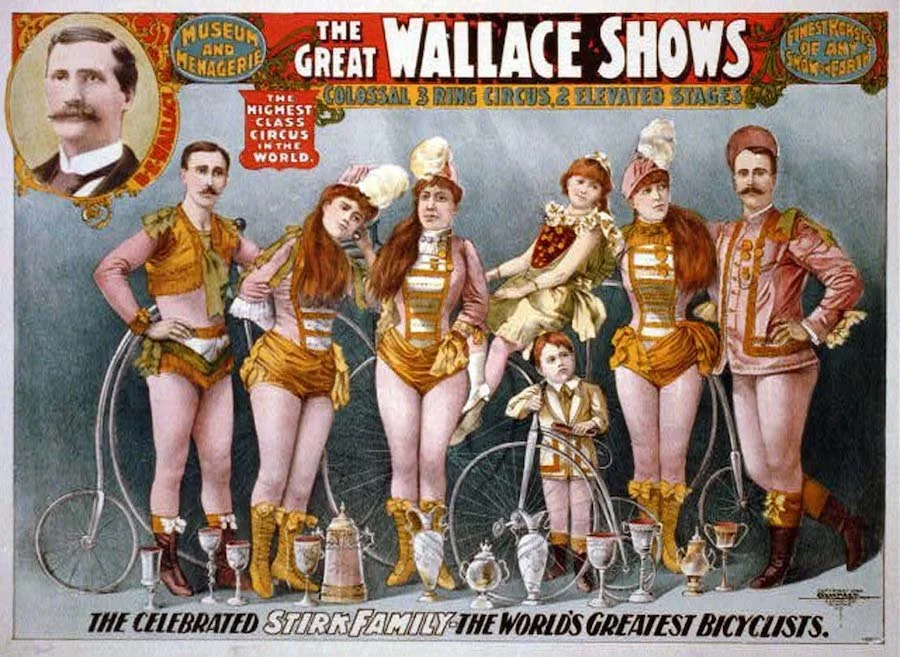
1898 Great Wallace Poster | Photo courtesy Library of Congress Collection
Up From the Mud
In the late 19th-century, traveling shows were brutally inefficient. Known in the trade as “mud shows,” circuses relied on horse-drawn wagons navigating unpaved, rutted country roads. It was a logistical nightmare that severely limited how far and how fast a show could move.
Then in came Ben Wallace, a Peru livery stable owner who bought a bankrupt circus at auction in 1884. Wallace realized something crucial: Peru wasn’t just a quiet river town; it was a burgeoning railroad hub. He took particular notice of how the Peru and Indianapolis Railroad offered a massive advantage. Within two years of launching his circus, Wallace transferred the entire operation to the rails. Utilizing flatcars and Peru’s extensive roundhouse facilities, he bypassed the mud and transformed a struggling local act into a highly efficient, national logistical machine.
The Winter City
Wallace’s operation eventually expanded, eventually absorbing the Hagenbeck trained animal show to become the massive Hagenbeck-Wallace Circus. As did its footprint in Miami County. By the 1920s, the winter quarters encompassed a sprawling 200-acre complex southeast of town.
When the touring season ended an the cold weather set in, Peru transformed. The scale of the infrastructure needed to maintain this fleet was mind-blowing:
The Menagerie: Massive concrete and wood barns housed over 50 elephants and hundreds of big cats and horses. Elephants became a common sight around the yards, utilized as heavy machinery to shunt railcars, haul refuse, and plow snow.
The Rail Fleet: Over 150 specialized railcars sat in the local train yards every winter, undergoing intensive maintenance, repair, and repainting for the upcoming season.
The Financial Engine: The influx of physical cash was so immense that Wallace founded his own bank, the Wabash Valley Trust. The bank’s third floor was completely commandeered by local seamstresses who spent the winter manufacturing thousands of costumes and heavy canvas animal blankets.
Monopoly and Collapse
The Peru operation eventually grew into the American Circus Corporation, managing five different national circuses out of the winter quarters. This huge consolidation created a virtual monopoly over the non-Ringling market.
The incredible centralization of entertainment infrastructure made Peru a target though. In the fall of 1929, and intimidated John Ringling traveled to Indiana with an ultimatum. To erase his fiercest competition, he purchased the entire American Circus Corporation for $1.7 million, seizing control of the Peru rail yards, and all associated assets.
The timing was terrible. Six weeks later, the stock market crashed. As the Great Depression ravaged the entertainment industry, the Ringling empire struggled under its new debt. The Peru quarters were systematically shuttered, dismantling a powerhouse that had operated flawlessly for decades. Today, while the massive trains are gone, the surviving barns serve as a testament to an era when Miami County engineered a railroad empire dedicated solely to the spectacular.
References & Further Reading
Miami County Historical Society: A primary repository for local records, archival photography, and historical banking documents detailing the economic impact of Ben Wallace and the Wabash Valley Trust.
The International Circus Hall of Fame: Located in Peru, Indiana, on the surviving grounds of the original winter quarters. Their archives house extensive physical artifacts, railcar maintenance histories, and documentation of the American Circus Corporation.
The Circus Historical Society: Publishers of the historical journal Bandwagon, which serves as a premier source for researched articles on 19th and 20th-century circus rail logistics, including the Hagenbeck-Wallace train operations.
