Public Enemy Number One: The Tale of John Dillinger.
When you look back at the history of Indiana, it’s hard not to run into the story of John Dillinger. He wasn't just some two-bit crook. For a little over a year, this guy had the whole country - and especially the folks here in the Hoosier state - in a grip of fear and fascination that we haven't seen since.
To understand how a kid from Indianapolis turned into "Public Enemy Number One," we have to go all the way back to the start.
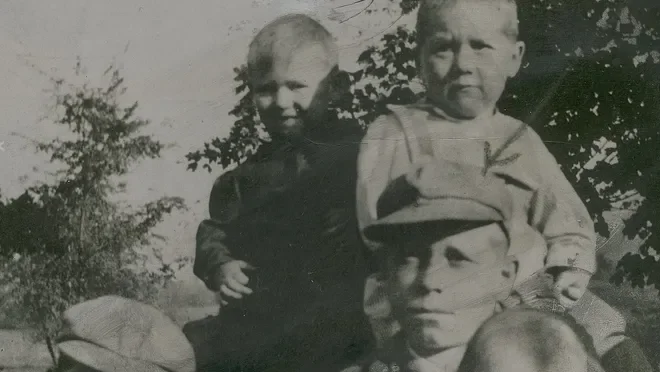
John Dillinger is in the cap that the arrow is pointing to.
An Early Start in Indianapolis
John Herbert Dillinger was born in June 1903 in Indianapolis. He lost his mom when he was only three, and he was raised by his sister and then his dad, who remarried when John was nine. His childhood was a mix of being coddled and being handled pretty rough by a father who was a strict disciplinarian.
By the time he was a teenager, he was already finding his way into trouble. He joined a local group called the "Dirty Dozen," petty theft became a hobby, and he eventually dropped out of school at 16. It wasn’t long before he tried to straighten his life out - he joined the Navy in 1923 - but he couldn't handle the rules and deserted after just a few months.
The Fall From Grace: Prison
The moment that really sealed his fate happened in 1924. He tried to rob a Mooresville grocer with a friend, and he got caught. He was barely 21, but he got a sentence that was way harsher than most folks expected: 10 to 20 years.
He spent the next nine years in Indiana prisons—first the Reformatory at Pendleton, then the State Prison at Michigan City. If you ask anyone who’s studied his life, they’ll tell you: he didn't go in a hardened criminal, but he sure came out as one. Prison was where he met the guys who would become his partners, like Harry Pierpont and Homer Van Meter. They didn't just pass the time; they studied the craft of bank robbery. When he finally got paroled in May 1933, he wasn't looking for a job in a factory. He was ready to settle a score.
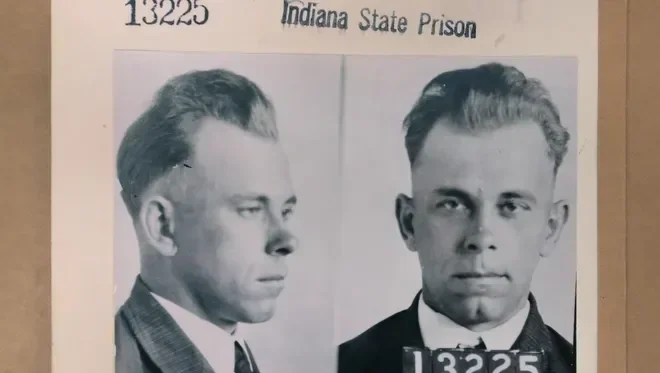
Indiana gangster John Dillinger's 1931 mugshot
From the Indiana State Prison; among documents stored in the Indiana State Archives, 6440 E. 30th St., Indianapolis.
The Great Midwest Crime Spree
Once he was out, he moved fast. Between 1933 and 1934, he and his gang hit banks across Indiana, Ohio, and beyond. They were famous for being efficient and bold. They didn’t just hit banks; they raided police arsenals in towns like Auburn and Peru, Indiana, making off with machine guns, rifles, and bulletproof vests. They had the local police completely outgunned.
He became a folk hero to a lot of people who were losing everything in the Depression. When the big banks were the ones taking away people's farms and homes, seeing someone walk in and hold them up felt like justice to a lot of suffering folks.
The Great Escapes
Dillinger is probably most famous for two things: his bank jobs and his escapes. After being captured and held in a jail in Lima, Ohio, his friends broke him out, killing the sheriff in the process.
But the one that really made him a national sensation happened right here in Crown Point, Indiana. He was held in the "escape-proof" Lake County Jail, guarded by hundreds of men. In March 1934, he famously used a fake pistol - some say it was carved out of wood and blackened with shoe polish - to force his way out past the guards. He even drove away in the sheriff’s own car, which made the authorities look absolutely foolish.
Where It All Came To An End
By the time he escaped from Crown Point, the feds were officially on his trail. J. Edgar Hoover and his "Division of Investigation" (which would become the FBI) made catching Dillinger their top priority.
His end came on a hot July night in 1934 in Chicago. A woman named Anna Sage - often called the "Lady in Red" - tipped off the authorities that she was taking him to the Biograph Theater. As he walked out of the movie, the law was waiting. He tried to run, but he didn't make it. At 31 years old, his run was over.
Dillinger left behind a complicated legacy. He was a violent man who hurt people, but he was also a product of a desperate time. For folks in Indiana, his story is a reminder of a period when the rules were being rewritten, and the line between outlaw and hero was a whole lot blurrier than it is today.
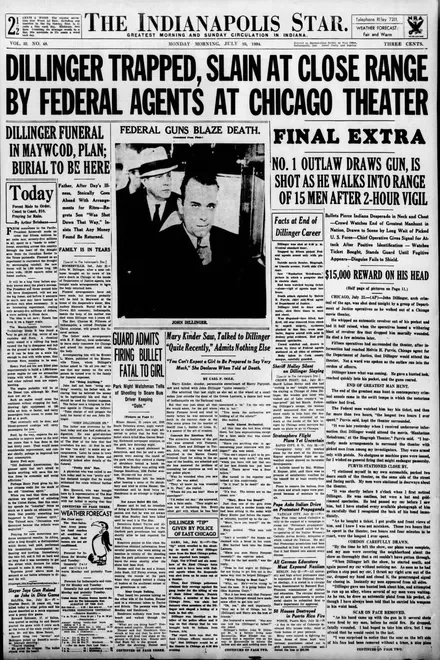
July 23, 1934 Indianapolis Star - John Dillinger killed outside the Biograph Theater in Chicago.
References
Beineke, L. (2019). Reviews. The American Mathematical Monthly, 126(4), 379–384. https://doi.org/10.1080/00029890.2019.1567230 Cited by: 1
Lathan, S. R. (2016). Experience of my famous uncle, Melvin Purvis, with Hoover's jealousy and with Nazi Hermann Göring. Baylor University Medical Center Proceedings, 29(3), 348–351. https://doi.org/10.1080/08998280.2016.11929465
Potter, C. B. (1995). "I'll Go the Limit and Then Some": Gun Molls, Desire, and Danger in the 1930s. Feminist Studies, 21(1), 41. https://doi.org/10.2307/3178316 Cited by: 18
Richman, D. C., & Seo, S. (2020). How federalism built the FBI, sustained local police, and left out the states. SSRN Electronic Journal. https://doi.org/10.2139/ssrn.3714325 Cited by: 23
