Down By the Headwaters: Kekionga - The Villages at the Maumee Headwaters.
Along the confluence of the St. Joseph and St. Mary rivers, and the Headwaters of the Maumee River. Sat a village of multiple tribes. A gathering place where decisions were made. Known to the Miami people as Kiihkayonki, and to later histories as Kekionga, this was far more than a mere settlement; it was the beating heart of the Miami Nation and a fulcrum upon which the fate of the American frontier turned.
To understand Kekionga is to understand the geography of power in the 18th-century Great Lakes region. It occupied the "keyhole" of the continent: the six-mile portage connecting the Maumee River (leading to Lake Erie) with the Wabash River (draining into the Ohio and Mississippi). Whoever controlled this strip of land controlled the internal trade artery of North America. As it was the shortest land portage between the Great Lakes, and Mississippi valley. It was a prime route for trade, and an anchor of influence for the native tribes of the Great Lakes region.
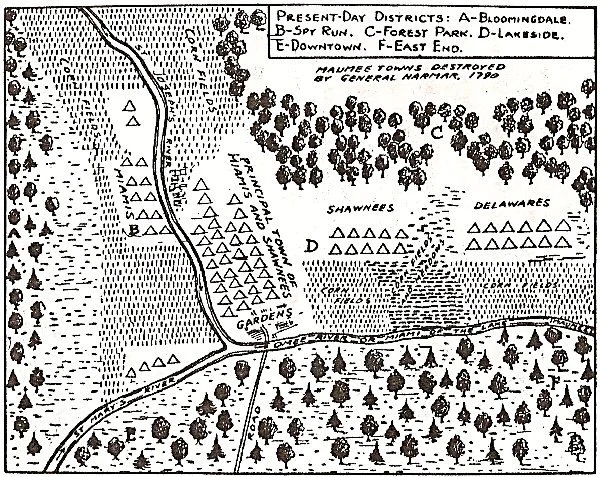
The Layout of Kekionga and the Surrounding Native Towns
Multiple tribes considered Kekionga a focal point for meeting, trade, and diplomacy. Central to the Miami people, and a gathering point and governmental center for the Miami, Shawnee, and Delaware tribes.
The Sacred Nexus
For the Miami, Kekionga was the center. While other villages were often seasonal or ephemeral, Kekionga was permanent - a nexus of diplomacy, commerce, and spiritual life.
The Physical Landscape: Encircled by the protective marshes of the Great Black Swamp, the site offered both defensive isolation and economic connectivity. It was a place of abundance: massive cornfields stretching along the riverbanks, complemented by pumpkin patches, bean rows, and thriving orchards.
The Social Fabric: It was an architectural marvel of its time, featuring wiccias (dome-shaped residences), bark-covered longhouses for council meetings, and log structures that blended indigenous tradition with the influence of French trade.
A Gathering Place: In the spring, when the thaw opened the rivers, families returned from winter hunting grounds to cultivate the fields and engage in the essential councils that defined tribal policy.
A Theater of Empires
Because of its strategic portage, Kekionga became an inevitable flashpoint for imperial ambition. The French, British, and eventually the Americans all recognized that capturing the village meant securing the interior. As colonists, they were never content with what they had. They always wanted more.
Throughout the 18th century, the Miami of Kekionga navigated a treacherous geopolitical landscape. They balanced relationships with French voyageurs - who offered trade goods and military alliances - against the encroaching pressure of British interests moving inland from the East. Even internal tribal politics, such as the mid-century tension between pro-French and pro-British factions, found their stage in the streets of Kekionga.
The Crucible of Resistance
By the late 1780s and 1790s, Kekionga had evolved into the primary symbol of Indigenous resistance to the young United States. As settlers poured across the Ohio River in defiance of treaties, the Miami, Shawnee, and other allied nations unified at this central location.
The climax of this struggle arrived in October 1790, when Brigadier General Josiah Harmar led over 1,400 troops toward the village, acting on orders from President Washington. What ensued - often categorized in textbooks as "Harmar’s Expedition" - was a foundational event in U.S. military history.
Little Turtle, the brilliant Miami war chief, understood that the strength of the U.S. Army lay in its numbers and its formation. He drew them out. He forced them into the forests and the river bottoms, away from their artillery, into a series of devastating ambushes. The battle at Kekionga proved that the nascent American military was not invincible. It was a victory so significant that it forced the U.S. to rethink its entire approach to the Northwest Territory, leading directly to the later, more destructive campaigns of "Mad" Anthony Wayne.
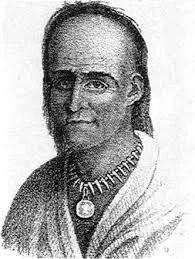
Mihšihkinaahkwa (pronounced Mish-i-kin-i-kwa), known in English as Little Turtle (c. 1747–1812), was one of the most prominent and strategically gifted leaders of the Myaamia (Miami) people during the late 18th century. His life spanned a transformative era in American history, marking the transition from traditional indigenous sovereignty to the encroachment of the United States in the Old Northwest.
The Legacy of the Ground
Kekionga was not just a battlefield; it was a home that endured for centuries until the forced removal of the Miami in 1846. Today, standing near the confluence in Fort Wayne, it is easy to see why the land was so fiercely contested. The rivers still flow with the same cadence that once moved the canoes of Miami families and the trade goods of three competing empires.
It remains a place where the physical geography of Indiana meets the weight of history—a reminder that the "Three Rivers" region was, and always has been, a center of gravity for the continent.

Maumee River Basin Map
By Kmusser - Self-made, based on USGS data., CC BY-SA 2.5, https://commons.wikimedia.org/w/index.php?curid=2116109
References
Ostler, J. (2016). ‘Just and lawful war’ as genocidal war in the (United States) Northwest Ordinance and Northwest Territory, 1787–1832. Journal of Genocide Research, 18(1), 1–20.
Lockridge, R. F. (1940). History on the Mississinewa. Indiana Magazine of History, 36(3).
Matthaidess, E. D. (2015). Our loss was heavy: Brigadier General Josiah Harmar's Kekionga campaign of 1790 [Master's thesis, U.S. Army Command and General Staff College]. Defense Technical Information Center.
Harvey, C. E. (2007). The Evolution of US Army Tactics in the Absence of Doctrine, 1779 to 1847. Defense Technical Information Center.
Keller, C. (1978). Archeology of the battles of Fort Recovery, Mercer County, Ohio: Education and protection. Ball State University.
