The Settlement Series: Vincennes
Neither the city we see today nor the bustling frontier capital it once was started with a grand plan. Much like the rest of the Wabash corridor, it began as a tenuous lifeline in the wilderness.
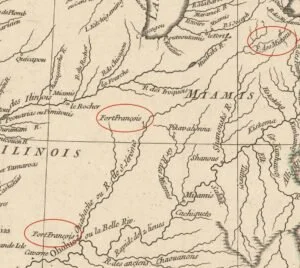
Excerpt from Anville map “Amérique septentrionale” 1746 showing three French forts
A Stronghold in the Mud (1732)
While Fort Ouiatenon served as a northern trade hub, the French realized they needed a southern anchor to secure the lower Wabash. In 1732, François-Marie Bissot, Sieur de Vincennes, established Poste des Pianguichats.
This wasn’t a huge fortress. It was a modest, strategic footprint intended to facilitate trade with the Piankeshaw people and maintain a French presence against encroaching British interests. It was a tough, isolated existence, but unlike many other ephemeral outposts, this one stood it’s ground.
The Seat of Power (1800)
Vincennes didn’t just survive, it evolved, leveling up from a modest outpost to a burgeoning capital. As the French influence faded, and the Americans moved in, the settlement became the epicenter of the new frontier. When the Indiana Territory was formally established in 1800, Vincennes was crowned the capital.
For a period, this muddy river town was the political heart of a massive territory that included what would eventually become Indiana, Illinois, Wisconsin, and Michigan. It was here that the foundational laws of our state were drafted and where the tensions between American expansion and Native American resistance reached a boiling point. Causing the events that lead to the Battle of Tippecanoe.
Surviving the Shift
The thing that makes Vincennes the logical next chapter after Ouiatenon is its endurance. While Ouiatenon was destroyed in 1791 and largely relegated to an archaeological site, the residents of Vincennes kept the lights burning. They bridged the gap between the era of French fur trading, the British frontier, and the dawn of the American statehood era.
It is the oldest continuously inhabited European-founded settlement in Indiana, proving that if you plant your stake in the right spot on the Wabash, you don’t just settle the land, you define the history that follows.
On Came the Industrial Revolution
When the frontier moved west, Vincennes found itself at a crossroads. It had been the center of the world for the Indiana Territory, but as railroads began to bypass the river routes that had sustained the town for a century, the city had to pivot. It wouldn’t be able to just be a historic river post; it had to become a manufacturing hub as well.
All Chuffed Up
Later in the 1800s, Vincennes had successfully reinvented itself as a major rail junction. The convergence of multiple lines, including the Baltimore and Ohio and the Pennsylvania Railroads, turned the old river town into a vital transportation node.
The accessibility to coal and transport meant that while other riverside settlements withered, Vincennes thrived. It didn’t just move people; it moved freight.
The Gas and Glas Boom
Vincennes caught the wave of the late 19th-century industrial booms that defined Indiana. The discovery of natural gas in the region sparked an aggressive period of manufacturing growth. The city leaned hard into the glass industry. At it’s height, the Vincennes glass works were supplying bottles and plate glass to the burgeoning national market.
The landscape of the town changed to match this new reality. The old, quiet streets of the French era were flanked by brick factories and the sound of whistles replaced the quiet lapping of the Wabash River. It was a gritty, hardworking period that saw the town’s population swell as laborers moved in to man the machines.
Time Marches On: Into the 20th Century
As the industrial era aged, Vincennes entered a period of stabilization. The early 1900s brought stability through diversified manufacturing, but the city also had to grapple with the shifting tides of the American economy. By the time the mid-20th century rolled around, the city wasn’t just a place where things were made, it was a place that was actively debating its future.
The pressure of the changing social and political landscape, particularly as the Civil Rights movement began to sweep across the nation, touched every corner of the Midwest. Even in and older city with deep-rooted traditions, the tension between the “old guard” of the industrial past and the call for modern equality started to manifest in local schools, housing, and public policy.
Vincennes entered the Civil Rights era not as a wild frontier settlement, but as an established, complex American city attempting to reconcile its long, layered history with the demands of a new, more equitable future.
References
1.1.1 City of Vincennes. (2026). Historical Overview of Vincennes, Indiana.
1.1.2 Wikipedia. (2026). Vincennes, Indiana.
1.2.1 Day, R. (2001). Capital of Indiana Territory. Indiana State Government Archives.
1.2.3 Indiana Historical Bureau. (n.d.). Territorial Capitol Records and History.
1.3.1 Indiana University. (n.d.). Unit 3: Industrialization and the Wabash Valley.
1.4.1 Hoosier History Live. (2021). African-American History in Late 19th Century Indiana.
1.4.2 Vincennes University Press. (2018). Socio-Economic Development in the Northwest Territory.
1.4.3 Indiana Historical Bureau. (n.d.). The Polly Strong Slavery Case: Legal Foundations of Civil Rights.
