A Trail of Death
Violence is rarely abstract. In the history of Indiana, it has a precise address, a ledger, and even a balance sheet. We often go about teaching history like a series of inevitable collisions—like “Manifest Destiny” sweeping across the frontier—but that’s just sanitizing these events; obscuring the mechanism behind them. When we look specifically at the Potawatomi Trail of Death in 1838, we aren’t looking at an unfortunate byproduct of expansion; we are peering at a calculated, state-sanctioned act of economic extraction.
The forced removal of the Potawatomi from their homes at Twin Lakes wasn’t driven by a sudden outburst of rage, but by the cold, quiet mechanisms of real estate speculation. For men like John Tipton and the settlers waiting in the wings, human lives were simply friction in the way of a transaction. When the state militia burned cabins, imprisoned leaders, and marched hundreds at gunpoint until they succumbed to typhoid and exhaustion, they were doing the work of the market. This is the clearest, most brutal definition of Greed is Violence: a reality where the desire for someone else’s land becomes the justification for the destruction of their existence. To understand the history of our state, we have to stop calling it “settlement” and start calling it what it was: a violent liquidation of the native people to balance a speculator’s books.
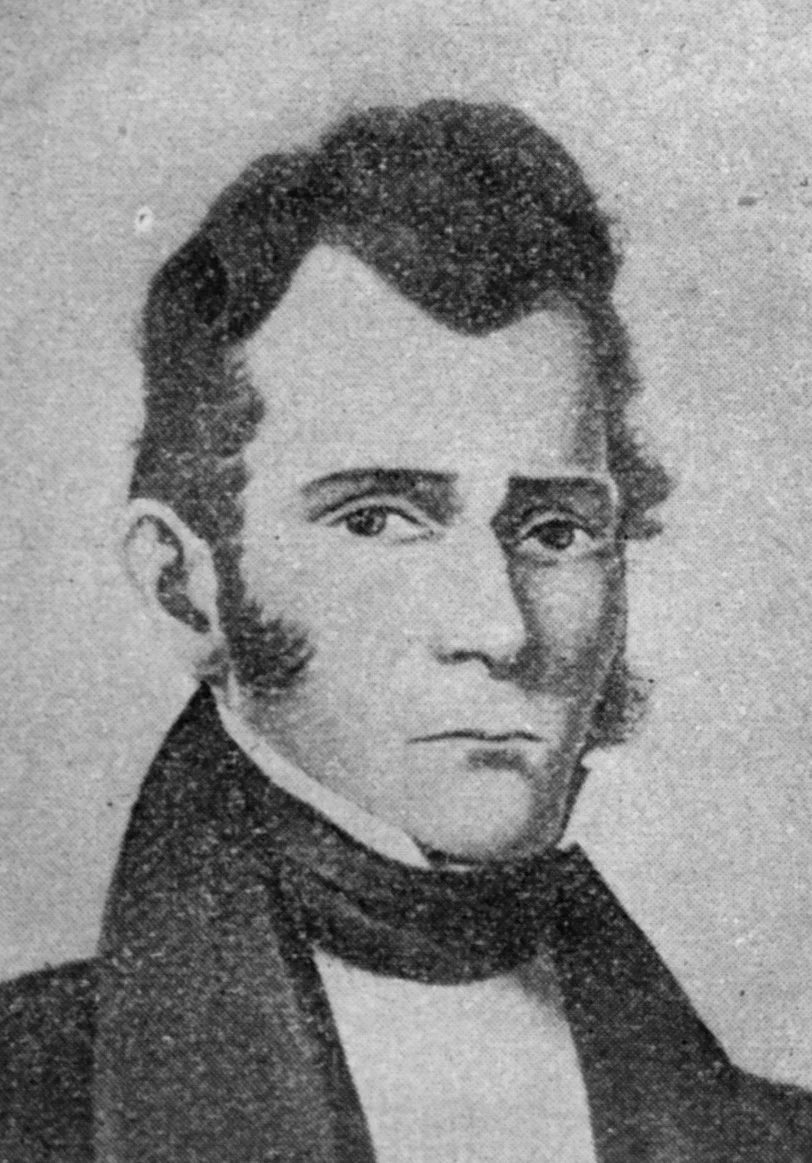
John Tipton (1900) The Who-When-What Book -
Who-When-What Company (https://commons.wikimedia.org/wiki/File:John_Tipton_(1786%E2%80%941839).jpg)
The Myth and the Mechanism
John Tipton’s biography reads like how we are taught to view early American heroes. Born in Tennessee in 1786, his father was killed by Native Americans when Tipton was a boy. He moved to Indiana, split rails to pay for his farm, joined the local militia, and fought under William Henry Harrison at the Battle of Tippecanoe. He was a self-made frontiersman who pulled himself up by his bootstraps to become a sheriff, a state legislator, and eventually a U.S. Senator.
But that is the sanitized version. That is the myth.
The reality is that Tipton was a highly effective ambitious bureaucrat who understood exactly who to wield state power to enrich himself and his political allies. He wasn’t a cartoon villain driven by pure, irrational hatred; he was far more dangerous. He was a businessman who saw native populations as an obstacle to capital.
The Architect of Conflict
The turning point for the Potawatomi—and for Tipton’s personal wealth—was his 1823 appointment as the United States Indian Agent for northern Indiana.
On paper, an Indian Agent was a diplomatic liaison responsible for managing trade, distributing federal annuities, and maintaining peace. In practice, Tipton operated like a hostile corporate raider. His explicit mandate from the state, and his own personal objective, was to extinguish all Native land titles in Indiana to open the door for white settlement and real estate speculation.
He didn’t just facilitate the transfer of the land; he personally profited from it. That dog Tipton formed land companies with other politicians to buy up the newly ceded territories at rock-bottom prices. He even moved the Indiana Agency to a settlement that would eventually become Logansport—a town he helped found and heavily invested in. He essentially directed federal funds and Native trade straight through his own real estate project.
Weaponized Debt
Tipton knew that violence didn’t always start at the end of a rifle; it often started with a ledger. He permitted, and sometimes encouraged, white traders to wildly overcharge the Potawatomi for basic goods.
Once the tribes inevitably ran up huge debts they could not pay off, Tipton would swoop in on behalf of the federal government. He offered a simple, brutal solution: the government would clear the Potawatomi’s debt to the traders, but only if the tribe signed away their land. It was a manufactured crisis designed to force a foreclosure on a massive scale.
By the time Governor David Wallace needed a military commander to forcefully march Chief Menominee and his people out of Twin Lakes in 1838, he didn’t pick a random soldier. He picked Senator John Tipton—the man who had the most political and financial capital tied up in ensuring the land was cleared.
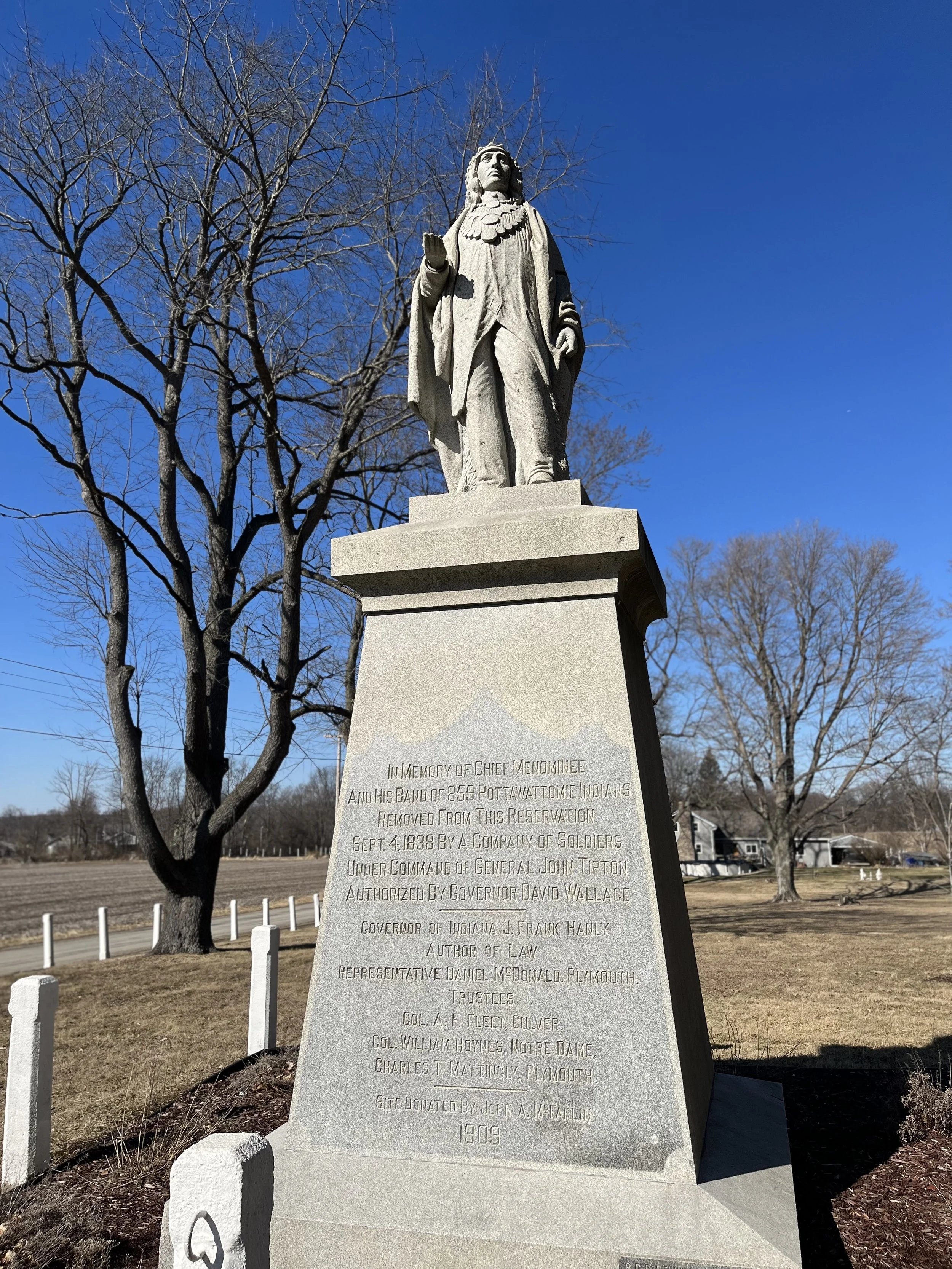
Monument to Potawatomi Chief Menominee erected in Plymouth, Indiana in 1909 (27 February 2022) Own Work - Kevinorear (https://commons.wikimedia.org/wiki/File:Chief_Menominee_Monument.jpg)
The Fraud of the Yellow River
The bureaucratic machine relied on a specific tactic to steal land: find a pliable or desperate chief, get them to sign a treaty, and them apply that treaty to all the tribes in the area, regardless of who actually lived there.
In 1836, the government pushed the Treaty of the Yellow River. Menominee, recognized the scam, and absolutely refused to sign it. He knew that the chiefs who did sign had no authority over his village at Twin Lakes. Menominee’s resistance was highly logical and rooted in sovereignty. He famously argued that the President of the United States had no right to buy land from men who didn’t own it, famously stating: “The Great Spirit put me here and bound me to this land. I will not sell it.”
Menominee didn’t just passively refuse; he actively petitioned Washington. He sent letters and appeals directly to the federal government, trying to use the American legal and diplomatic systems to prove the treaty was fraudulent. He was trying to beat the bureaucrats at their own game by exposing the illegality of the sale.
The Stronghold of Twin Lakes
Since Menominee refused to leave, his village at Twin Lakes transformed from a simple settlement into a focal point of resistance.
As other Potawatomi bands were displaced by aggressive white squatters and earlier treaties, many of them fled to Twin Lakes. Menominee took them in. His village became and undeniable, physical roadblock to the real estate speculators. He was proving that the Potawatomi would not simply evaporate when a piece of paper was signed in Washington.
For the speculators who had already “bought” the land and the squatters who were eager to farm it, this peaceful, legal resistance was infuriating. Menominee was holding up the transaction.
The Bureaucracy Fails, The Violence Begins
Here is the climax of our contrast. Menominee had successfully jammed the gears of the bureaucratic machine. Stuck it fast and proven the treaty was a fraud and he had held his ground peacefully.
Because the speculators could no longer use “the law” to remove him, they had to drop the mask. The state abandoned negotiations and authorized Tipton to use the militia.
On September 4, 1838, Tipton invited Menominee and other leaders to a "council" at the village chapel. It was a trap. The moment Menominee stepped inside to negotiate in good faith, Tipton’s men surrounded the building, bound the chiefs, and declared them prisoners of war on their own land.
To ensure the symbol of resistance was utterly broken, Tipton didn't just force Menominee to walk; he had the Chief placed in a cage constructed in the back of a wagon, parading him like a captured animal as his village burned behind him.
The contrast is stark: Menominee fought with petitions, logic, and a defense of his home. Tipton fought with fraudulent paperwork, armed mercenaries, and a cage.
A Trail of Sorrow
The violence of the market did not end when the fires at Twin Lakes burned out; it simply moved onto the trail.
The 660-mile forced march to Kansas began in September of 1838, during one of the most severe regional droughts in recorded history. Water sources had completely dried up, leaving the air choked with a blinding dust that coated the lungs of the marchers. Guarded by armed militiamen, the Potawatomi were pushed to their physical limits and fed insufficient rations of rancid meat and bad flour. It was a perfect breeding ground for typhoid and dysentery.
Father Benjamin Petit, a Catholic priest who accompanied the tribe, recorded the grim reality in his journals: children dying in their mothers' arms, hurriedly buried in shallow graves alongside the trail while the militia pushed the survivors forward. More than forty Potawatomi perished on the journey, the vast majority being infants and the elderly. Their bodies were left behind in the dirt as collateral damage in the state’s relentless pursuit of real estate. This was the ultimate human cost of doing business—lives quietly extinguished to ensure the ledgers in Indianapolis and Washington balanced perfectly.
This Isn’t the End
We do ourselves a disservice when we treat the Trail of Death as a closed chapter from 19th-century history. John Tipton is long since died, and the frontier militias have been disbanded, but the underlying mechanism—the bureaucratic prioritization of profit over human lives and homes—has never stopped running. If we look at our communities today, we still see the echoes of that same relentless extraction. The machinery has simply evolved. Instead of fraudulent treaties and armed guards, we see aggressive housing consolidation and localized economic pressures, where corporate ledgers dictate who is allowed to remain in a community and who is quietly displaced. The violence ahs been sanitized into evictions and priced-out neighborhoods, but the core equation remains untouched: treating human homes as nothing more than friction in the way of a transaction. The Potawatomi were the victims of a system that fundamentally believed land and capital were worth more than people. Until we recognize that this exact same strain of greed continues to inflict structural violence on our neighbors today, we will never truly understand our history—or how to fight it.
Primary Sources
The Trail of Death: Letters of Benjamin Marie Petit (Compiled by the Indiana Historical Society). This is the essential primary source for the march itself. Father Petit's firsthand accounts of the sickness, the grueling pace, and the daily death toll provide the visceral evidence of the state's cruelty.
The John Tipton Papers (Compiled by the Indiana Historical Bureau). For readers who want to see the bureaucracy of greed in action. These volumes contain his correspondence, financial ledgers, and military orders, proving his dual role as a state enforcer and private land speculator.
Treaty with the Potawatomi, 1836 (Treaty of the Yellow River). Pointing readers to the actual text of the treaty allows them to see the legal fiction used to justify the removal of Menominee’s village.
Secondary Historical Texts
The Potawatomis: Keepers of the Fire by R. David Edmunds. This is widely considered the definitive, comprehensive history of the Potawatomi people. Edmunds provides the crucial broader context of the tribe's sovereignty, culture, and their ongoing resistance against American expansion leading up to 1838.
Potawatomi Trail of Death: Indiana to Kansas, 1838 by Shirley Willard and Susan Campbell. Published in association with the Fulton County Historical Society in Indiana, this is the most localized and meticulously researched breakdown of the march's exact route, the daily logs, and the specific individuals involved.
Digital & Indigenous Resources
The Citizen Potawatomi Nation Cultural Heritage Center (Online). It is vital to include a resource managed by the Potawatomi themselves. Their digital archives and historical articles offer the narrative of the Trail of Death from the perspective of the descendants of the survivors, emphasizing resilience alongside the tragedy.
The Potawatomi Trail of Death Association (Online). A great resource for readers who want to see modern maps of the 660-mile route, historical markers (like the Menominee monument), and ongoing efforts to memorialize the march across Indiana, Illinois, and Missouri.

.jpg)
