Ascension St. Vincent Kokomo
Originally named St. Joseph Memorial Hospital, Ascension St. Vincent Kokomo, is an amazing example of poetic justice for Midwestern history. It is a tale of patient endurance, a buried medal, and economic collapse that completely inverted a project built entirely out of malice.
I am writing the unabridged history of how a group of determined women were able to outlast the most powerful hate machine in 1920s America.
Setting the Stage: Ten Cents and a Levee Failure (1912-1914)
To really grasp how sweet a climax this story has, you have to look at how the Catholic presence in Kokomo healthcare started.
In 1912, a local doctor reached out to the Sisters of St. Joseph of Tipton, Indiana. At the time, the entire congregation numbered just 38 sisters, who had their duties split between teaching and nursing. Kokomo had no formal, centralized hospital, only a few private beds in doctors’ personal clinics.
The Sisters had arrived ready to build, but the community’s initial reception was absolutely frigid. For three grueling days they walked door-to-door, canvassing Kokomo neighborhoods for donations. After twenty-four hours of constant rejection, their grand total collected was exactly ten cents.
Instead of packing it in and walking away, they adapted. A local doctor who was sympathetic to their endeavor allowed them to convert the old Bates homestead on East Vaile Avenue into a temporary, 12-bed facility called Good Samaritan Hospital. They opened it’s doors for the first time on February 6, 1913.
Only a week later, the Great Flood of 1913 struck. Nearby a levee collapsed, inundating the surrounding neighborhoods. The Sisters worked around the clock in a flooded, chaotic setting, proving their medical utility to a skeptical town. Having realized the immense convenience of a local hospital, the city finally backed a second fundraising campaign. Which allowed the Sisters to buy a proper building and open a 60-bed facility on Union Street in November 1914.
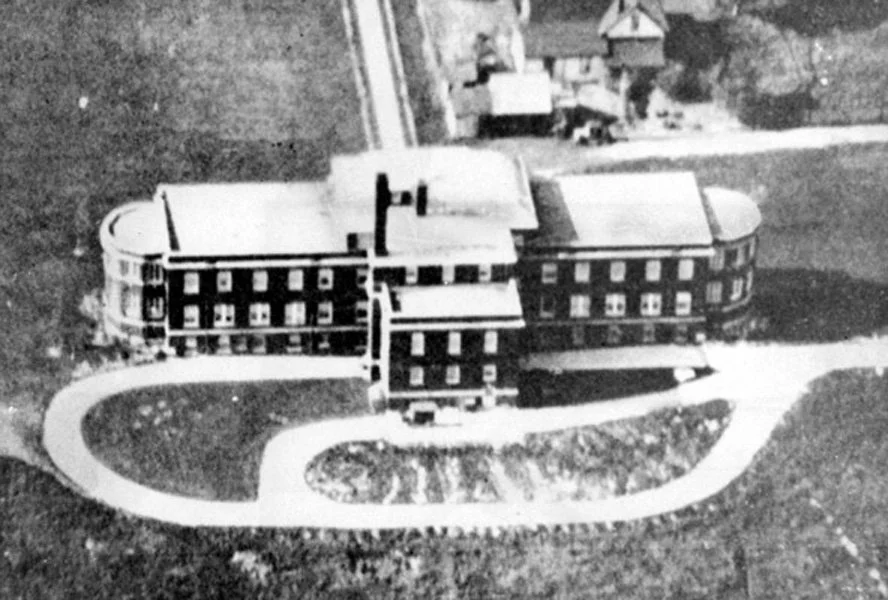
Howard County Hospital circa 1925
Turning the Page: The 1923 Konklave and the Spite Hospital
By the time the 1920s rolled around, Indiana had become the epicenter for the “Second Klan,” a political monster being lead by Grand Dragon D.C. Stephenson. Unlike the Reconstruction-era Klan, this version focused their efforts on immigrants, Jews, and specifically Catholics as existential threats to American morality.
Kokomo was their citadel, their crown jewel. On July 4th, 1923, Kokomo hosted the infamous Grand Konklave, drawing an estimated 200,000 hooded Klansmen to Malfalfa park.
During the height of the fervor, the Klan decided they would flex their muscles directly at the Sisters. Mother Gerard, the head of the Good Samaritan Hospital, wrote that the Klan intentionally routed a massive nighttime parade down Union Street and Vaile Avenue, marching right past the hospital windows in full regalia to attempt to terrify the patients and intimidate the nuns.
Intimidation wasn’t enough though. The local Klan leadership declared that Protestant citizens should not have to “suffer the indignity of being born and dying in a Catholic hospital.”
They weaponized a massive fundraising machine, gathering more than $50,000 in hate-driven capital. They used these funds to give to the Howard County Hospital Association to construct a rival, “purely American” facility. They procured a 17-acre farm plot on West Sycamore Street, and in 1924, broke ground on what would be known as the Howard County Hospital.
The Buried Medal
The oral history from the Sisters records an awe inspiring moment of quiet defiance during groundbreaking in early 1924. On a Sunday afternoon, a few of the Sister stook a carriage ride out to the edge of the Klan’s new construction site on West Sycamore. Sister Louise quietly stepped out of the carriage, walked over to the property line, and deliberately buried a Medal of St. Joseph deep into the soil.
The Klan-backed hospital opened its doors in 1925, built specifically to put the Catholic Sisters out of business.
Then Came the Collapse and the Reclamation (1930-1936)
The triumph in this history really comes to light; when you see how rapidly and thoroughly the Klan’s machine crumbled, undone by its own corruption.
In late 1925, Grand Dragon D.C. Stephenson was arrested and subsequently convicted for the brutal murder of Madge Oberholtzer, destroying the Klan’s facade of “moral purity.” By the end of the decade, the Indiana KKK’s political power had all but disappeared.
Once the Great Depression choked off the American Economy in 1929, the spite-built hospital on West Sycamore Street, already suffering from poor financial management, fell apart. In a twist of ironic fate, a wealthy local man named Henry Fisse went to the Klan-supported hospital for treatment in 1930. The cash-strapped facility turned him away because he couldn’t pay upfront. Fisse walked away, altered his will, and left the entirety of his estate to the Sisters of St. Joseph instead.
By late 1930, the Klan-funded hospital went entirely belly up, and locked its doors. For five years, the grand brick building sat vacant, a hollow monument of a defunct movement.
Meanwhile, the Sisters of St. Joseph were thriving, completely outgrowing their Union Street facility. In 1935, using the steadily managed resources and the fruits of their community goodwill, the Catholic Sisters purchased the abandoned, bankrupt Klan hospital building.
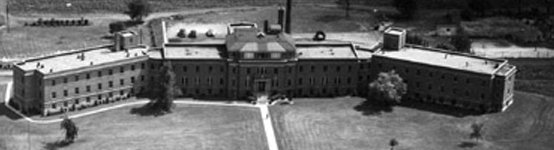
St. Joseph Memorial Hospital circa 1936
An Enduring Legacy
The Sisters didn’t rip down the building, they redeemed it. Spending months purging the property of its history, modernizing the surgical wings, upgrading the equipment, and expanding it’s capacity.
In May 1936, the building was officially dedicated as St. Joseph Memorial Hospital.
The halls designed to keep Catholics out, were now filled with the rustle of the Sisters’ habits. For the next several decades, those same nuns provided unconditional medical care to every single man, woman, and child of Howard County, absolutely blind to race, religion, or background.
With time the hospital did eventually transition to the Daughters of Charity in 1994, joining the St. Vincent Health network in 1998, and stands today as Ascension St. Vincent Kokomo. While the original 1920s brick facade has been largely enveloped by modern medical expansions, its foundation rests on a plot of land the Klan bought to sew division, and in the dirt, lay a medal, hidden by a nun, who dropped it into the dirt to claim it for healing.
Primary & Institutional Sources
Howard County Historical Society (HCHS)
Source Document: "A Century of Service - St. Joseph Hospital" (Published via the HCHS Museum Archives).
Details Verified: Documented the initial ten-cent door-to-door canvas, the purchase of the old Bates homestead on East Vaile Avenue, and the oral history of Mother Gerard regarding the carriage ride where Sister Louise buried the Medal of St. Joseph at the edge of the West Sycamore site in early 1924. It also preserves the record of Henry Fisse's subsequent estate gift that funded the Sisters' successful $20,000 bankruptcy bid.
The Catholic Health Association of the United States (CHA)
Source Publication: "St. Joseph of Kokomo, Ind., marks centennial" (Catholic Health World, Vol. 29, No. 5).
Details Verified: Confirmed institutional timelines, including the 1912 arrival of the 38 original foundresses (the Sisters of St. Joseph of Tipton, Indiana), the transition through the 1913 Great Flood, and the specific Klan fundraising drive to build a competing "County" hospital so local Protestants wouldn't have to suffer the "indignity of being born and dying in a Catholic hospital."
Sisters of St. Joseph of Tipton Institutional Archives
Historical Sketch: "History of the Sisters of St. Joseph of Tipton, 1888–2012" (Preserved via the St. Joseph Retreat and Conference Center).
Details Verified: Details the foundational expansion of the Sisters' nursing and teaching ministries throughout north-central Indiana (including Kokomo, Marion, and Wabash), tracing the exact operational evolution from Good Samaritan Hospital to the acquisition of the Sycamore Street facility.
Contextual & Era References
Indiana Historical Society & Indiana State Library
Archival Collection: "Ku Klux Klan in Indiana Subject Guide" / Konklave in Kokomo by Robert Coughlan.
Details Verified: Provides the broader political backdrop of the "Second Klan" in Indiana during the 1920s, the operational dynamics of Grand Dragon D.C. Stephenson, and the logistics of the July 4, 1923, Grand Konklave at Kokomo's Malfalfa Park that drew an estimated 200,000 participants.
The Indiana Magazine of History (IMH)
Source Analysis: Research by Professor Edward Safianow (Indiana University Kokomo) regarding the intersection of the 1920s Klan, local civic organizations, and the institutional resistance of minority communities in Tipton and Howard counties.
