THE Debs Democrat
Way before he ever became the five-time Socialist candidate for President or the nation’s most famous political prisoner, Eugene V. Debs was something else entirely: a mainline, elected Indiana Democrat. History remembers him for his radical clashes with the feds and his towering presence in the labor movement, his political origins were deeply entrenched in the localized, pragmatic machinery of 19th-century Hoosier politics.
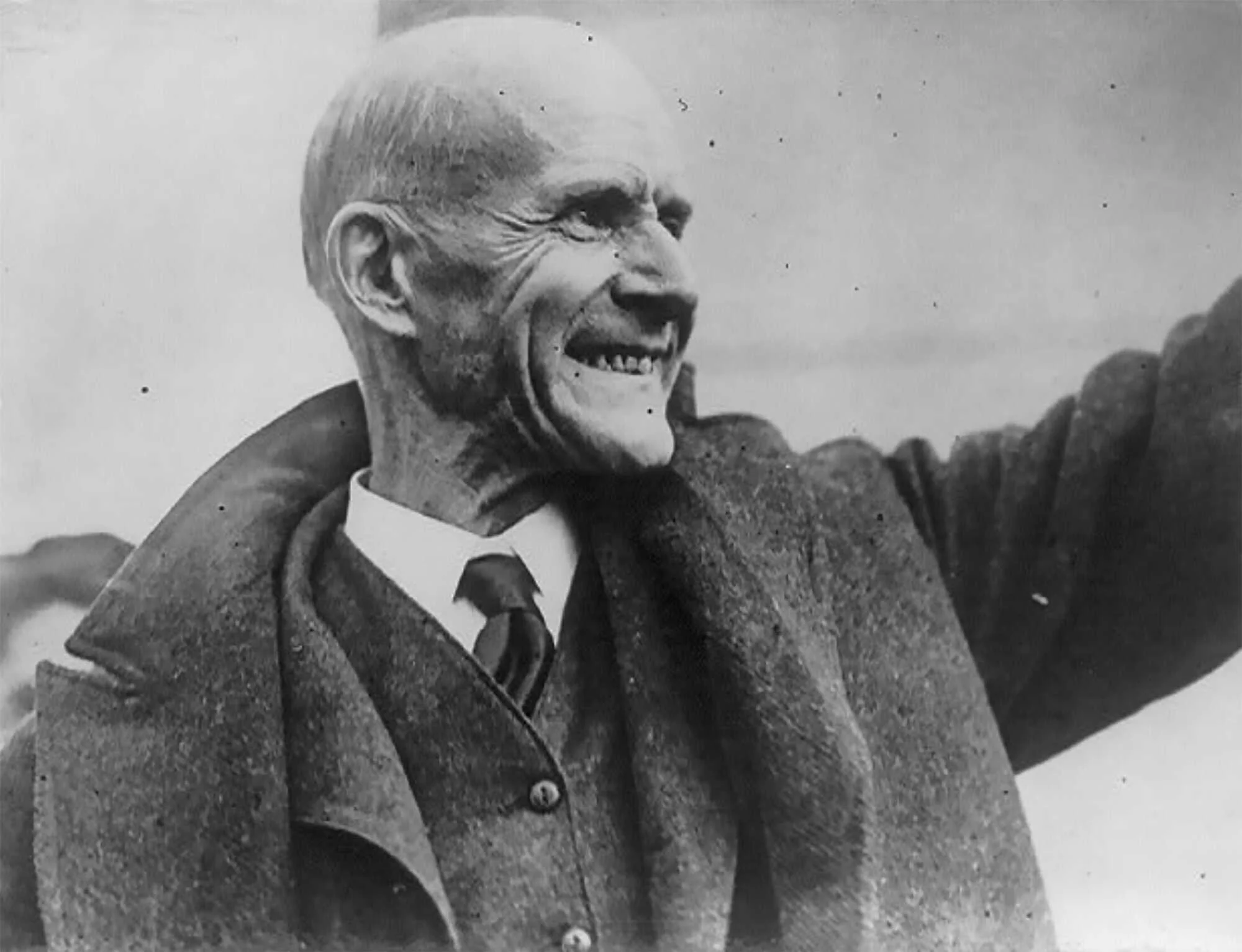
Eugene V. Debs, 5 times Socialist candidate for President, set free from prison on Christmas Day. 1921. Courtesy: Library of Congress
Hailing From Terre Haute
In the late 1870s and early 1880s, Terre Haute was booming, serving as a critical artery for the nation’s rapidly expanding railway system. Debs, serving two terms as the city clerk, learned the ropes managing the day-to-day civic functions of a city defined by the railroad. He didn’t push for a systemic overhaul of the economy at this stage; he was more focused on functional governance, infrastructure management, and the immediate needs of the community.
His local popularity propelled him into a successful run for the Indiana General Assembly. Elected to the Indiana House of Representative in 1884 as a Democrat, Debs arrived in Indianapolis during an awe-inspiring era of legislative transition. He was stepping into the statehouse still adapting to the major shift in Indiana’s constitutional amendments that had occurred in 1881, a grand restructuring that had modernized the state’s judicial system and altered voter qualifications.
The Legislative Railroad
During his only term in the state legislature (1885), Debs’s primary focus remained fiercely tied to the working conditions of railwaymen. That very same infrastructure boom that was laying the groundwork for the state’s eventual massive electric railway networks and interurban systems was heavily reliant on grueling, extremely dangerous labor.
As a Democrat, Debs attempted to work within the established legislative framework to pass bills protecting railroad employees. He championed legislation to hold railroad companies liable for injuries resulting from defective machinery or the negligence of corporate officers. He was able to push his liability bill through the House, but it was terribly watered down and effectively gutted by the state Senate before passage.
The Hair That Broke the Camel’s Back
That particular legislative defeat was a turning point in the making of the Eugene Debs the world would eventually come to know. The realization that the existing political apparatus, and the legislative avenues they controlled, were inherently sympathetic to corporate railroad monopolies over the workers who built and operated the infrastructure was a rude awakening.
Utter disillusioned with the compromises of statehouse politics, Debs chose not to seek reelection to the General Assembly. The “Debs Democrat” faded, replaced by a man who realized that organizing labor across entire industries, rather then relying on the traditional party structure, was the only viable way to challenge the immense power of Gilded Age monopolies.
Shifting Into Socialism
Debs’s disillusionment with the political establishment culminated during his imprisonment following the 1894 Pullman strike, where his beliefs shifted to closely mirror the tenets of European socialist labor movements. On his release, he emerged as a prominent speaker for the Socialist Party and officially ran as their presidential nominee for the first time in 1900.
While he lost that initial bid, Debs continued as the party’s candidate in subsequent elections, finding his greatest mainstream success during the highly fractured 1912 race. Running against Democratic nominee Woodrow Wilson, incumbent William Howard Taft, and Theodore Roosevelt, Debs managed to catch nearly a million votes, representing six percent of all ballots cast.
The Price of Pacifism
After four consecutive presidential campaigns, Debs shifted his focus in 1916, running for an Indiana Congressional seat on a strict pacifist platform that advocated for American neutrality in World War I. Once the United States entered the conflict, however, his outspoken stances made him a target of the federal government.
He made a speech in 1918, in Canton, Ohio, which he was arrested afterwards for violating the restrictive new Espionage Act. Although Debs actually only mentioned the war a single time during the address, the local district attorney condemned it as an anti-war speech. Leading to a ten-year sentence in a federal penitentiary.
Prisoner 9653
Debs’s Incarceration set the stage for a remarkable political anomaly that left an indelible mark in American history. Nominated by the Socialist Party for a fifth time in 1920, Debs actively campaigned for the presidency from his federal jail cell, once more securing over a million votes.
Despite the mounting pressure and repeated pleas from Deb’s supporters, President Woodrow Wilson stubbornly refused to grant him clemency. It eventually fell to Wilson’s successor, President Warren G. Harding, to finally order Debs be set free on Christmas Day in 1921.
A Hoosier Legacy
Prison had physically broken Debs by the time he was released, but upon his release and return to Terre Haute he received a hero’s welcome from his hometown. He spent the remainder of his years at his home in Indiana, continuing to write and advocate for the working class until his death in 1926.
As we look back at the trajectory of his life, it is an incredible lens through which we view the growing pains of modernizing America. He didn’t just read about the massive economic shifts of the Gilded Age; he shoveled coal into the engines of the very railroads that drove them. He didn’t just philosophize about workers’ rights; he tested the boundaries of the legal system and fundamental limits of the First Amendment on a national stage.
In the end, Debs remains one of the most complex figures to ever emerge from the Crossroads of America. He leveled up from a localized, pragmatic city clerk and state legislator into a political lightning rod who fundamentally challenged the relationship between American infrastructure, corporate power, and constitutional freedoms.
References
Ginger, Ray. The Bending Cross: A Biography of Eugene Victor Debs. (Source material for Debs's 1885 legislative term in the Indiana General Assembly and his subsequent break from the Democratic Party).
PBS American Experience. "Eugene V. Debs." Woodrow Wilson. Available at: https://www.pbs.org/wgbh/americanexperience/features/wilson-eugene-debs/ (Source material for Debs's presidential campaigns, his pacifist platform, the Canton speech, and his eventual pardon).
Image Credit: Eugene V. Debs, 5-time Socialist candidate for president, set free from prison on Christmas Day, 1921. (File: wilson-eugene-debs-loc-eugene-v-debs-5-times-socialist-candidate-for-president-set-free-from-prison-on-christmas-day-1921.jpg__2000x1533_q85_crop_subsampling-2_upscale.jpg).
