The “Red Summer” Riots
The term “Red Summer” was coined by a civil rights leader and NAACP field secretary by the name of James Weldon Johnson. It refers to a bloody wave of white-supremacist terrorism and racial riots that swept across more than 30 American cities between April and November of 1919.
The ember that lit the blaze was a volatile mis of the Great Migration (hundreds of thousands of Black Southerners moving to the Northern and Midwestern industrial hubs) and the return of millions of World War One veterans. Black soldiers arrived back home demanding the democracy they had fought for abroad, while white citizens and workers, fearing labor competition and the upending of social hierarchies, brought weaponized violence to force them back down.
Historians generally mark the Charleston Race Riot of May 1919 as the first major urban clash of that bloody season.
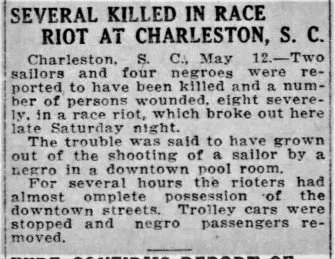
“Several Killed in Race Riot at Charleston, S.C.” article in the El Paso Herald, May 12, 1919.
Source: Visualizingtheredsummer.com
The First Flames: Charleston, SC (May 10-11, 1919)
Back in 1919, Charleston was a critical naval hub. The locals were already tense due to overcrowding and competition between civilian laborers and the massive influx of military personnel.
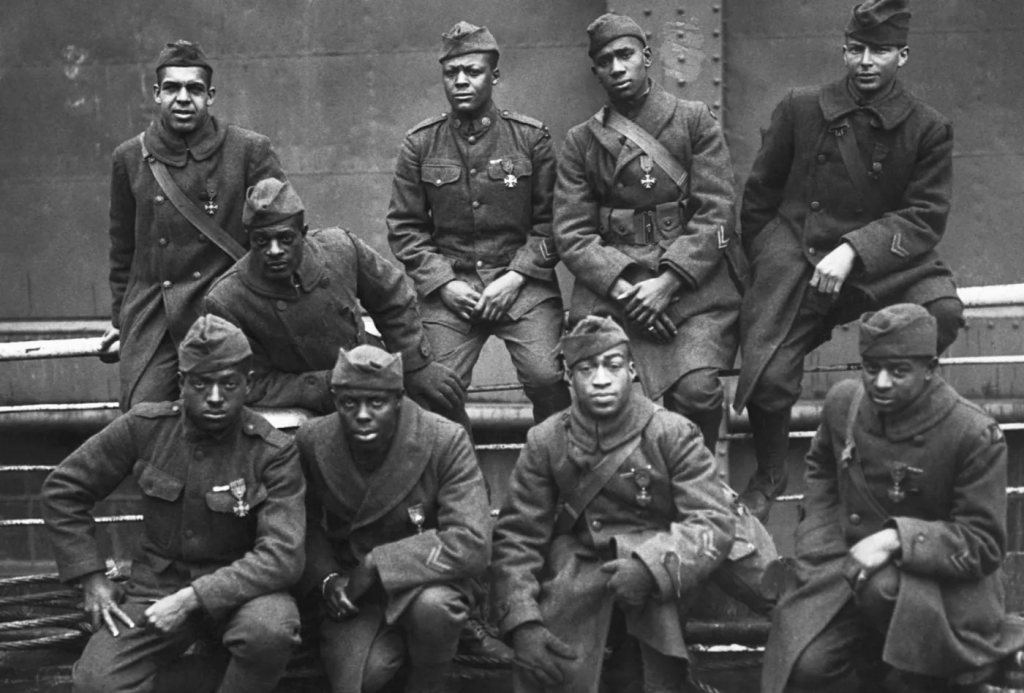
Returning Black WWI veterans faced severe hostility as they asserted their rights at home.. Source: Avery Research Center - College of Charleston / Lowcountry Resistance Part 2 by Mateo Mérida – Avery Research Center
The Spark
On the evening of Saturday, May 10, a rumor ripped through the white naval barracks. It was claimed that an African American man had cheated or attacked a white U.S. Navy sailor during a dispute over a hidden stash of illegal liquor (cocaine was also mentioned in some local rumors).
Without waiting for verification, a mob of roughly 1,000 white sailors, joined by local white civilians, marched directly into Charleston’s predominantly Black commercial and residential districts.
The Escalation
The riot quickly devolved into a full-scale assault. Armed with clubs, knives, and firearms stolen from naval supplies or looted from local pawnshops, the mob attacked Black citizens on the streets and began destroying Black-owned businesses.
The Attack on the Press: The mob targeted the offices of the Charleston Messenger, a prominent Black-owned newspaper, smashing its windows and press equipment because the paper advocated for racial equality.
The Black Response: Unlike earlier eras of racial violence where victims had few options but to flee, the Black community in Charleston, heavily populated by resilient workers and veteran families, heavily armed themselves and actively fought back to protect their homes, families, and businesses. Street battles erupted across the city center.
Martial Law and Aftermath
As local police stood by or found themselves completely overwhelmed, the Mayor of Charleston requested assistance from the military command. By the early hours of May 11, the United States Marines and additional naval guards were deployed to the streets, effectively placing the city under martial law.
A subsequent Naval investigation explicitly found that four U.S. sailors and one white civilian had initiated the entire riot. The final toll of the weekend's violence revealed:
3 Black men killed: Isaac Doctor, William Brown, and James Talbot.
Injuries: At least 18 Black men and 5 white men were severely wounded.
Property: Dozens of Black-owned shops were entirely looted or structurally ruined.
The Charleston riot set a terrifying template for the rest of the summer: white military personnel or citizens instigating violence based on unverified rumors, followed by fierce armed self-defense by Black communities, concluding with state or federal military intervention.
That Was Only the Beginning
Longview, Texas
July 11-13, 1919
A white mob burned down the Black housing district, angered that a local Black schoolteacher, S.L. Jones, had published an article in the Chicago Defender exposing a local lynching. Black citizens organized an armed defense, wounding several white attackers before fleeing.Washington, D.C.
July 19-23, 1919
Sparked by sensationalist media rumors of a Black man arresting a white woman, white servicemen launched four days of random beatings. Black citizens, including many WWI veterans, formed defensive perimeters and fought back. It is one of the few times white fatalities (10) outnumbered Black fatalities (5). President Wilson eventually deployed the National Guard.Chicago, Illinois
July 27-August 3, 1919
The deadliest urban riot of the summer. It began when a Black teenager, Eugene Williams, drowned after being pelted with rocks by white beachgoers for crossing an invisible segregation line in Lake Michigan. 13 days of fighting left 38 dead (23 Black, 15 white) and over 500 injured.Omaha, Nebraska
September 28, 1919
A white mob of thousands stormed the Douglas County Courthouse to seize Will Brown, a Black worker falsely accused of rape. They lynched him, burned his body, and nearly hanged the city's white mayor for trying to protect him.Elain, Arkansas
September 30-October 1, 1919
The single bloodiest conflict of the era. Black sharecroppers organizing a union were fired upon by white operatives. The resulting hysteria saw the U.S. Army and white militias hunt down Black residents in the countryside. Estimates of Black deaths range from 100 to over 200.
Can’t Count Indiana Out
While Indiana’s most notorious and devastating acts of the 20th-century racial terror occurred a bit later. Like the rapid political rise of the Indiana Ku Klux Klan under D.C. Stephenson in the 1920s and the horrific 1930 Marion lynchings. Our state was not spared during the Red Summer of 1919.
In mid-July of 1919, the national contagion of white mob violence broke out in the Circle City, manifesting as the Garfield Park Riot of 1919.
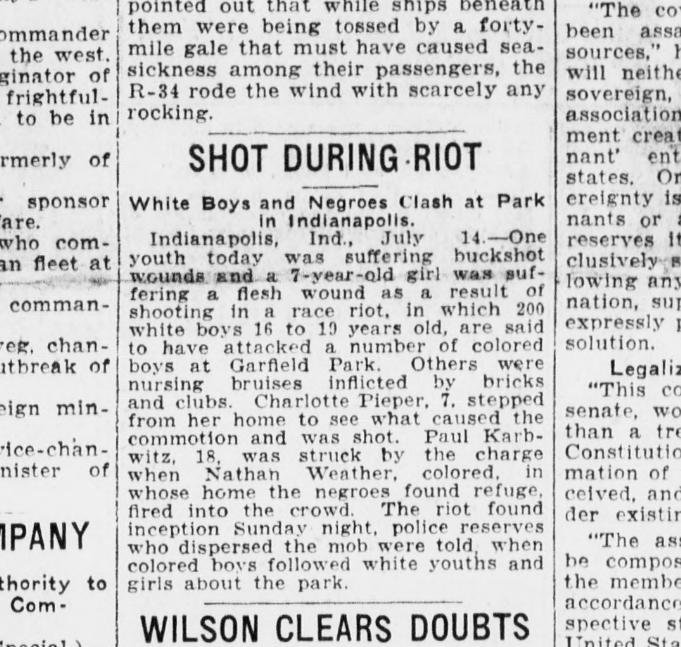
By The Chattanooga news - The Chattanooga news., July 14, 1919, Image 1, Public Domain, https://commons.wikimedia.org/w/index.php?curid=80581555
The Garfield Park Riot (July 14, 1919)
Located on the city's south side, Garfield Park was a major recreational hub for Indianapolis. Like many Northern and Midwestern cities at the time, Indianapolis was experiencing an influx of Black families arriving during the early waves of the Great Migration, which stoked deep-seated resentment among working-class white residents who viewed public spaces, housing, and industrial jobs as their exclusive domain.
The Catalyst
On Monday, July 14, 1919, a group of white youths idling in Garfield Park convinced themselves that they were being "followed" or monitored by groups of African Americans. No actual conflict or assault had taken place, but amidst the sensationalized national news of racial clashes elsewhere that summer, the rumor was all it took.
By evening, word had spread. A mob consisting of hundreds of white teenagers and young men, mostly between the ages of 16 and 19, converged on Garfield Park with a singular, coordinated objective: to violently purge the park of any Black residents.
The Attack and Armed Self-Defense
Armed with clubs, bricks, and stones, the white mob began a sweeping assault through the park, brutally beating every African American person they came across.
As Black park-goers fled for their lives, a group of targeted individuals sought refuge inside the nearby home of Nathan Weather, a local Black resident whose house sat near the perimeter of the park violence.
The white mob did not stop at the property line. They tracked the fleeing people to the residence, surrounded the house, and began attacking the structure, threatening to breach it.
Recognizing that law enforcement was either too slow to arrive or failing to protect his property and the people inside, Nathan Weather took up a firearm to defend his home. Standing his ground, he fired a shotgun directly into the advancing crowd to disperse the attackers.
The Casualties and Aftermath
The gunfire successfully broke the momentum of the mob, forcing them to scatter just as the Indianapolis Police Department finally arrived in force to quell the wider rioting and clear the park.
However, the chaotic exchange left multiple people wounded:
Charlotte Pieper, a seven-year-old white girl who was an onlooker near the edge of the crowd, received a painful flesh wound from a stray piece of buckshot.
Paul Karbwitz, an 18-year-old member of the crowd, was also struck and wounded.
Multiple Black victims suffered severe lacerations and blunt-force trauma from the initial clubbing and brick-throwing inside the park.
While the Garfield Park Riot did not escalate to the catastrophic death tolls seen in Chicago or Elaine, Arkansas, it perfectly captured the hyper-volatile nature of Indiana's home-front tensions in 1919. It proved that even in a city like Indianapolis, ordinary white citizens were ready to form vigilante mobs over mere perceptions of displacement, and it further solidified the defining characteristic of the Red Summer: Black citizens refusing to back down, actively using armed self-defense to preserve their lives and homes.
References
1. The Charleston Race Riot (May 10–11, 1919)
The Haynes Report (1919): Haynes, George Edmund. Racial Conditions in the United States. U.S. Department of Labor, Bureau of Negro Economics. Washington, D.C.: Government Printing Office.
Note: This official federal report, compiled by Dr. George E. Haynes, was requested by the U.S. Senate to investigate the causes and statistics of the 1919 urban riots, specifically detailing the Navy's culpability in Charleston.
Contemporary Press Coverage: "Sailors and Negroes Clash in Charleston." The New York Times, May 11, 1919, p. 1.
Organizational Records: National Association for the Advancement of Colored People (NAACP) Papers. Part 7: The Anti-Lynching Campaign, 1912–1955, Series A: Legal Department Files. Library of Congress. (Contains field reports and telegraph correspondence regarding the defense of the Charleston Messenger and local Black residents).
2. The Garfield Park Riot, Indianapolis (July 14, 1919)
The Encyclopedia of Indianapolis: "Garfield Park and Conservatory." Indiana Historical Society / Indianapolis Public Library Digital Archives.
Note: This serves as the localized geographic and municipal record confirming the timeline of the July 13–14 clash at the park entrance and the subsequent retreat to the neighborhood perimeter.
Contemporary Press Coverage: "Shot During Riot: White Boys and Negroes Clash at Park In Indianapolis." The Chattanooga News, July 14, 1919, Vol. 32, No. 106, p. 1.
Note: Picked up by the national press wire on the day of the riot, this front-page dispatch details the actions of Nathan Weather, the age demographics of the 200-strong white mob, and the specific names of the wounded bystanders (Charlotte Pieper and Paul Karbwitz).
National Summary Records: "For Action on Race Riot Peril: Federal Council of Churches Asks Standard Treatment for Negro." The New York Times, October 5, 1919. (Includes Indianapolis in the comprehensive national registry of cities impacted by civil unrest during the summer and autumn of 1919).
