From Drill Bit to Drill BOOM
In the late 1880s, if you stood outside at night anywhere in East Central Indiana, you could read a newspaper by the light of the sky.
It weren’t the moon doing it though. Nope, that was the flambeaux - massive, roaring towers of flaming natural gas burning 24 hours a day, 7 days a week. For a short, wild period of time at the end of the 19th century, Indiana wasn’t just a crossroads of agriculture; it was the home of the largest natural gas discovery in the history of the world.
And Indiana absolutely lost it’s mind over it.
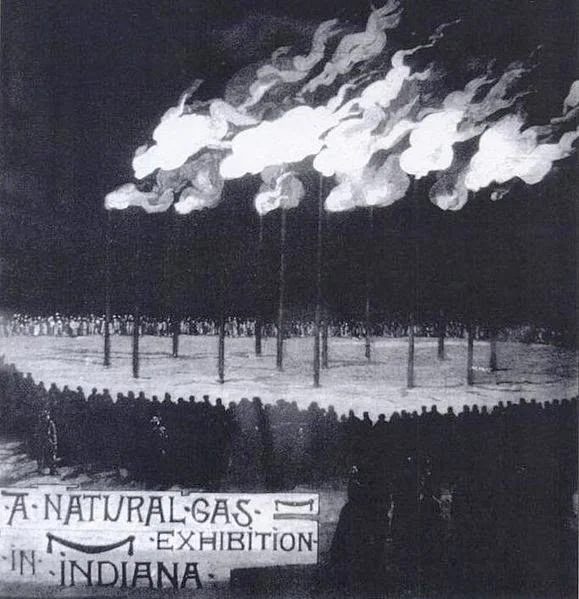
Although wasteful, natural gas demonstrations attracted crowds — and manufacturers like Kokomo Opalescent Glass Works, which continues to operate today. Photo from Leslie’s Illustrated Magazine, January 18, 1889.
The Trenton Field Gets Tapped
The tale originates with a false alarm. In 1876, coal prospectors were drilling in Eaton, and they hit a pocket of gas so pungent they thought they’d breached hell itself. They immediately plugged the hole and ran.
It would take another ten years, and a successful gas strike in Ohio, for investors to remember that weird, smelly hole in Delaware County. In 1886, they returned, drilled down to 922 feet, and struck the Trenton Gas Field. Up from the ground erupted a geyser of gas that shot flames 10 feet into the air.
They had blindly stumbled into a subterranean reservoir spanning over 5,100 square miles across 17 counties.
The Industrial Fervor of “Free Fuel!”
Almost overnight, sleepy little agricultural towns transformed into cutthroat industrial boomtowns. The logic was easy: gas was seemingly infinite, and factories needed heat.
Local governments and fast-talking promoters began offering massive incentives to lure Eastern manufacturers: free land, thousands of dollars in cash bonuses, and the promise of unlimited, free natural gas.
The strategy worked flawlessly.
The Glass Invasion: The Ball Brothers relocated from New York to Muncie to make glass jars, helping dub the town "The Magic City."
Heavy Industry: Tinplate mills, ironworks, and brickyards sprang up across the gas belt.
The Interurban Catalyst: This sudden, massive influx of capital, factories, and workers required a way to move people fast. The immense wealth generated by the gas boom directly bankrolled the heavy infrastructure required to build Indiana's legendary electric interurban railway network, linking these newly minted industrial hubs.
That boom even hit Wells county Indiana. By the late 1880s, wells were being sunk all over the county. Bringing the fervor, and the flames, straight into the Bluffton area.
Burning Down the House to Stay Warm
The absolute arrogance of the era is mind-warping when you look back at it. Because they couldn’t see the bottom of the reservoir, drillers assumed there wasn’t one.
To advertise this “limitless” resource to passing trains and potential investors, towns erected the flambeaux. Millions of cubic feet of natural gas were intentionally set on fire and left to burn in the open air, simply to prove they could. Streetlights burned continuously because it was cheaper to leave them on than to hire a man to turn them off at dawn.
The waste was absolutely the nail in the coffin for the gas field. Of the estimated one trillion cubic feet of natural gas extracted during the boom, historians estimate 90% of it was wasted. Vented right into the atmosphere or burned inefficiently.
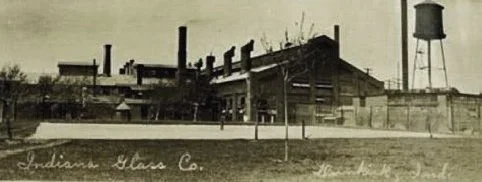
In 1907, Indiana Glass Company consolidated several failing glass companies in Dunkirk — and imported Kentucky and West Virginia coal to create its own gas.
When Boom Goes to Bust
Geology doesn’t give a hoot about municipal marketing. By 1902, the pressure at the Trenton Field was failing. The roar of the flambeaux sputtered out.
What is worse, drillers had discovered the field also held roughly a billion barrels of crude oil. But oil requires the immense pressure of natural gas to push it to the surface. When the state literally burned through the gas pressure, the oil stopped moving. To this day, an estimated 900 million barrels of crude remain permanently stranded underground in East Central Indiana.
By 1910, the “limitless” Indiana Gas Boom was dead, kaput, post mortem.
The cheap fuel was just gone! However the infrastructure it paid for. The interurban rails, the massive factories, and a skilled workforce, were left behind. The gas boom had fundamentally rewired the state, transforming Indiana from a quiet agricultural economy to the industrial and automotive powerhouse that defined its 20th Century.
References & Further Reading
American Oil & Gas Historical Society. "Indiana Natural Gas Boom." AOGHS.org. (A fantastic breakdown of the geological specifics of the Trenton Field and the staggering loss of crude oil pressure).
Blocker, Jack S. "Black Migration to Muncie, 1860–1930." Indiana Magazine of History, vol. 92, no. 4, 1996, pp. 297–320.
Glass, James A., and David Kohrman. The Gas Boom of East Central Indiana. Arcadia Publishing, 2005. (Highly recommended for its extensive photographic history of the region during the frenzy).
Glass, James A. "The Gas Boom in East Central Indiana." Indiana Magazine of History, vol. 96, no. 4, Indiana University Press, Dec. 2000, pp. 313–335.
Gray, Ralph D. Indiana History: A Book of Readings. Indiana University Press, 1995.
