They Killed My Elder Sibling
I wasn’t the first Constitution of Indiana. No, we had a version that was actually very well constructed. However, due to many pressures and constraints on a burgeoning state that was growing rapidly. They gutted my older sibling and buried them in the dirt. In the ashes of their destruction, I was written. To become the supreme law of the land. This is the tale of my older sibling. Who was torn asunder and re-written into something ugly and exclusionary. I’m wording it this way, because if we are to learn from the past. We have to understand it’s full impact.
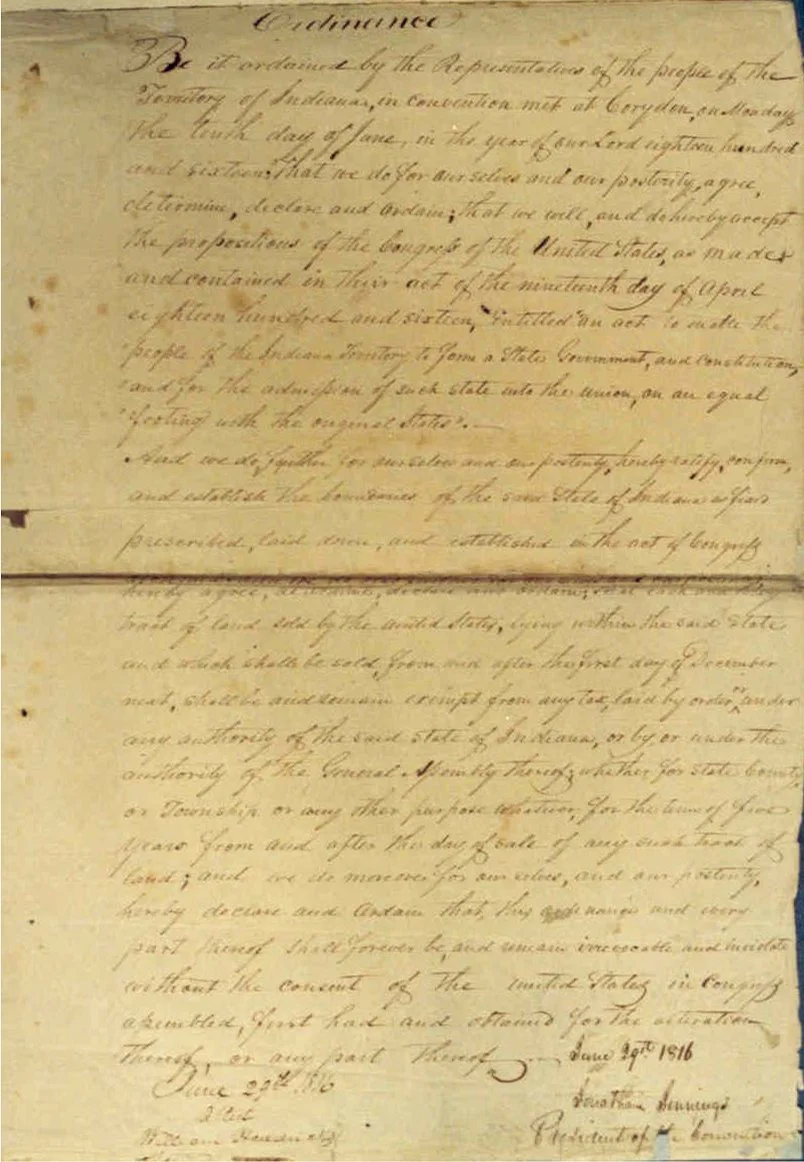
1816 Indiana Constitution
On 13 May 1816, delegates for the constitutional convention were elected. They met in Corydon, Harrison County, on 10 June and adjourned soon after, on 29 June, their work done. The delegates were able to work so quickly because they essentially adopted a standard constitution. For the most part, they simply copied from the Ohio Constitution of 1802 and the Kentucky Constitution of 1799. The total cost of the convention was $3,076.21.
What Happened?
To understand why they killed 1816, you’ll have to look at what was happening at the time. You have to look at the massive, chaotic growth that happened in Indiana between 1816 and 1850. The 1816 document was built for a small frontier territory; by 1850, it was failing to manage a booming state.
Financial Burdens
This is the single biggest reason. In 1836, the state government launched an incredibly ambitious (and reckless) plan to build canals, roads, and railroads across Indiana. They borrowed massive amounts of money to pay for it, believing the projects would pay for themselves.
The Result: The state went broke. The canals were largely failures, quickly rendered obsolete by the arrival of the railroad.
The Constitutional Response: The 1851 authors were terrified of this happening again. They "killed" the 1816 document’s flexibility and wrote a new one that strictly prohibited the state from incurring debt. This is why Indiana has historically operated with a very lean, surplus-focused budget.
The "Special Legislation" Plague
Under the 1816 Constitution, the General Assembly spent most of its time passing "local or special laws" - legislation that only applied to a single town, county, or private company.
The Problem: It clogged the system, created endless opportunities for corruption and patronage, and made the legislature look like a "favored-nations" club for whoever had the best lobbyist.
The Constitutional Response: The 1851 convention wanted to stop the "mischief." They banned the legislature from passing these special laws and limited the General Assembly to biennial sessions (meeting every two years instead of annually) to keep them from getting into trouble.
The Population Explosion & Governance
In 1816, Indiana had about 64,000 people. By 1850, there were nearly one million. You’d have thought the people were breeding like bunnies. The 1816 system - where many key officials were appointed by the legislature rather than elected - felt increasingly like an "old-fashioned" and exclusionary system in the age of Jacksonian Democracy.
The Shift: The 1851 convention wanted to put more power directly into the hands of the voting public (specifically white males). They increased the number of elected officials - including judges, auditors, and treasurers - to make the government feel more "by the people." Which I guess isn’t so bad. It’s always good to have your government be elected instead of appointed.
The Stain On My Pages
While the 1816 Constitution was silent on racial settlement, the 1851 Convention was driven by a wave of intense racial anxiety and nativism. Which still reverberates to this day throughout the state.
The Act: They took the opportunity of the rewrite to codify Article 13, which explicitly prohibited African Americans from entering or settling in Indiana.
The Takeaway: This wasn't just a byproduct; it was a central feature. They were essentially defining the "ideal" Hoosier as white and native-born (or naturalized), and they used the new constitution to build a legal wall around that definition. Basically, I was written by a bunch of white racist men, who probably believed in phrenology also known as skull reading.
This particular Article of me was painful as they scribed it. I’m glad I got it excised in 1881.
Why It Matters!
We talk about the 1851 Constitution as if it belongs to the dead, but we are effectively living in the house they built. The choices made by those delegates in the mid-19th century - born from financial panic and racial exclusion - didn't just change the law; they calcified the state’s identity.
1. The Shackle of "No Debt"
When the 1851 delegates decided to ban state debt to prevent another "canal disaster," they didn't just stop the bleeding; they stopped the growth. For nearly 175 years, this "no debt" dogma has made it incredibly difficult for Indiana to invest in massive, transformative public infrastructure projects. Every time you see crumbling local infrastructure or a lack of investment in modern energy or transit, you are seeing the lingering effects of the 1851 panic. We are still trying to build a 21st-century future with a 19th-century financial straightjacket.
2. The Part-Time Government
By limiting the General Assembly to biennial sessions to stop them from passing "special laws," the 1851 authors created a "citizen-legislature" that is largely detached from the realities of rapid social and technical change. A state of nearly 7 million people requires consistent, nuanced governance. Instead, we have a part-time system that often struggles to keep up, creating a vacuum where lobbyists and outside interests - rather than the public - frequently fill the void.
3. The "Ghost" of Article 13
Perhaps most importantly, Article 13 was the moment Indiana decided who belonged. Even though the 13th and 14th Amendments eventually hollowed it out, the spirit of exclusion didn't die in 1865. That legal wall established a culture of "insiders" and "outsiders" that has echoed through the state’s history - from the racial tensions of the 1920s to the systemic disparities we see in our modern urban and rural divides. When we talk about "taking back the history," we are acknowledging that the 1851 document tried to define Hoosier identity as something exclusionary. Our work now is to rewrite that definition.
The Bottom Line
The "death" of the 1816 Constitution was a tragedy of lost potential. It was the moment Indiana stopped trying to be a progressive, ambitious commonwealth and started trying to be a fortress.
When you close this article, don't just look at the words - look at the state. We are the architects of the next constitution. We have to decide if we are going to continue living in the "house" they built, or if it is finally time to stop apologizing to the ghosts and build something that actually serves the living.
References
Bates, F. G. (1933). The borrowing power under the "casual deficit" proviso of the Indiana Constitution. Indiana Law Journal, 8(6), 1–17.
Dionisopoulos, P. A. (1958). Indiana, 1851, Alaska, 1956: A century of difference in state constitutions. Indiana Law Journal, 34(1), 1–25.
Field, O. P. (1941). Unconstitutional legislation in Indiana. Indiana Law Journal, 17(2), 101–127.
Rogers, C. (2005). Black and white in Indiana. Indiana Business Review, 80(2), 1–3.
Rush, L. H., & Miller, M. F. (2024). Cultivating state constitutional law to form a more perfect union—Indiana's story. Notre Dame Journal of Law, Ethics, and Public Policy, 38(1), 1–24.
Varble, D. W. (2014). Legislation and its effects on race relations in southeastern Indiana, 1785-1860 [Master's thesis, University of Louisville]. ThinkIR: The University of Louisville Institutional Repository.
Willis, H. E. (1930). Revision of the Indiana Constitution. Indiana Law Journal, 5(5), 1–15.
