The Kingsland Tragedy
Located on the north side of US 224 and Market St. In Kingsland Indiana stands a lone plaque. Installed there in 2019 by the Indiana Historical Bureau and Wells County Historical Society. It’s a modest reminder of a horrible tragedy that took place on the Kingsland track on September 21, 1910.
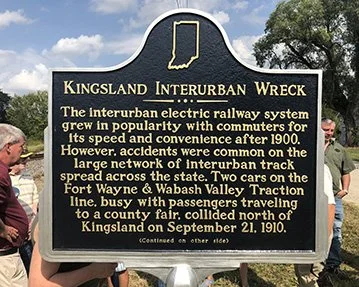
Kingsland Interurban Wreck
Plaque located at: US 224 and Market St. Kingsland (Wells County), Indiana 46777
That plaque reads: “The interurban electric railway system grew in popularity with commuters for its speed and convenience after 1900. However, accidents were common on the large network of interurban track spread across the state. Two cars on the Fort Wayne & Wabash Valley Traction line, busy with passengers traveling to a county fair, collided north of Kingsland on September 21, 1910.” (Side One)
“The larger car failed to pull over at the appointed switch and telescoped the smaller car on a blind curve. Forty-one passengers died, despite the efforts of local residents. The Kingsland wreck led to strengthened safety protocols, such as automated signaling, which caused accidents to decrease. The interurban declined by 1930 with the rise of the automobile.” (Side Two)
A Fatal Collision
On a bright autumn Wednesday, the Fort Wayne & Wabash Valley Traction line was packed with passengers heading south to the Wells County Fair in Bluffton.
The setup of this tragedy was even more marked by the fact there were so many riders this day. An overloaded, smaller northbound wooden passenger car was bound for Fort Wayne. Meanwhile, a much larger, heavier southbound car failed to pull over at an appointed siding switch to let it pass.
The two cars met on a completely blind curve, in a head-on collision just north of Kingsland. Because the cars were constructed primarily of wood, the massive southbound car literally punched its way inside of the smaller coach, “telescoping” inside it and crushing the passenger compartment to a sliver of it’s former length.
Forty-one passengers were killed almost instantly, or died of their injuries not much long after. The sheer scale of the tragedy paralyzed nearby communities like Bluffton, forcing local businesses and schools to close for days of collective mourning.
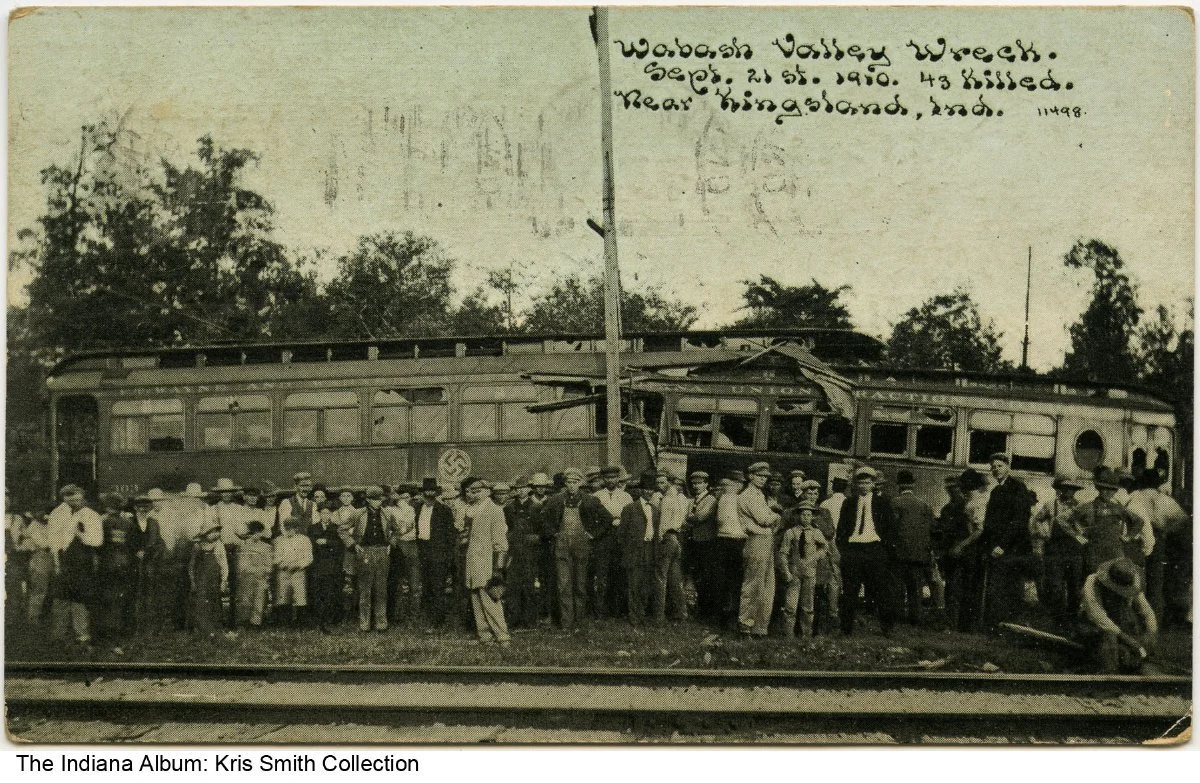
The photo shows people looking at a wrecked train. The caption reads Wabash Valley wreck. Sept. 21st 1910. 43 killed. Near Kingsland Ind. Postmarked 1912.
(source: https://indianaalbum.pastperfectonline.com/photo/9DAAC496-622D-41B3-B949-894204138038)
This Changed Everything
Before Kingsland, the interurban network relied on a horribly flawed dispatch system. Orders were called in verbally, and hand-written by crews. Which was a process highly susceptible to miscommunication or human error. Additionally, cars lacked uniform structural reinforcement.
The sheer outcry from the public and media frenzy to follow forced the traction company into bankruptcy and caught the immediate attention of state regulators. By 1912, the disaster catalyzed the massive legislative push in Indiana, which mandated:
Automated Block Signaling: Moving away from verbal orders to synchronized electronic track signals.
The Shift to Steel: Phasing out fragile, wood-bodied coaches in favor of heavy steel combines.
This tragedy exposed the dangerous gaps in early 20th-century mass transit. The safety protocols born from the ashes did end up saving countless lives across the remaining decades of the Interurban Era.
Primary Contemporary Sources (1910)
Electric Traction Weekly, Vol. 6, No. 39 (September 24, 1910): Published just three days after the disaster, this trade journal provides the earliest technical and mechanical breakdown of the collision, specifically detailing the structural differences between the wooden Union Traction car and the heavy steel-framed Wabash Valley coach.
Electric Railway Journal, Vol. 36, No. 14 (October 1, 1910) – "The Human Element in Train Operation": This industry analysis focused heavily on the failure of the verbal dispatching and hand-written order system used by the Fort Wayne & Wabash Valley Traction line, framing Kingsland as the ultimate proof that manual dispatching was obsolete.
The Indianapolis Star (September 24, 1910) – "Traction Report Blames Two Men": Coverage of the initial state investigation and the Railroad Commission of Indiana's fast-tracked inquiry into the motorman and conductor of the southbound car who overran the designated siding switch.
Public & State Records
Annual Report of the Railroad Commission of Indiana (1910/1911): The official state government publication documenting the spike in interurban fatalities (94 deaths across the state system in that fiscal year, with 41 coming solely from Kingsland) and containing the formal safety mandates presented to the Indiana General Assembly.
Indiana Historical Bureau (IHB) State Marker Files: The state's compiled research and verified annotation pack used for the permanent installation of the Kingsland Interurban Wreck historical marker (Dedicated 2019 at US 224 & Market St.).
