The Working Squeeze
We are all feeling the financial burdens of inflation. Some more than others, and most especially those in poverty who can’t afford for their expenses to keep climbing. Today we are exploring the systemic reason so many of us are struggling today. It’s rooted in the deep history of this nation, and no plainer to see in a state that is selling out to the largest corporations in the world.
To understand how we arrived at a reality where paychecks evaporate before the bills are paid, we have to look at how wealthy has been systematically redirected over the last century. Indiana’s history is scarred by instances where corporate profit was prioritized over human livelihoods. Tragedies like the 1925 City Mine Disaster weren’t just isolated historical footnotes; they were the starkest examples of an industrial machine that extracted wealth from the working class while leaving local communities to bear the physical and financial fallout. Generational wealth was destroyed before it ever had a chance to grow.
There was a time when the tide briefly turned. The labor movements of the early 20th century, punctuated by watershed moments like the 1937 GM strikes, forced a necessary rebalance. Working-class families organized to demand a fair, tangible share of the immense wealth they were generating on the assembly lines. For a time, this collective leverage created a foundation of steady income, homeownership, and upward mobility.
But that foundation has been methodically dismantled. As our local and national economies transitioned away from robust manufacturing toward precarious, service-based labor, the bargaining power of the average worker was intentionally weakened. This deindustrialization occurred alongside a monumental macroeconomic shift in how our money works.
Today, we operate under a fiat system heavily burdened by a soaring national debt. The constant expansion of the money supply to prop up this immense borrowing creates a silent tax on everyone holding a dollar. When the system prints more money than the economic engine can genuinely back up, the purchasing power of the working class inevitably shrinks.
This is the modern squeeze: the leverage to demand better wages has been stripped away, while the currency those wages are paid in is continually devalued. It is slow, systemic erosion of wealth that ensures the larges corporations and financial institutions remain insulated—often subsidized—while the average person is forced to take on individual debt just to cover basic necessities. The inflation we are battling isn’t merely a temporary market fluctuation or a string of bad luck; it is the mathematical result of a system build to extract wealth from the bottom and funnel it to the top.
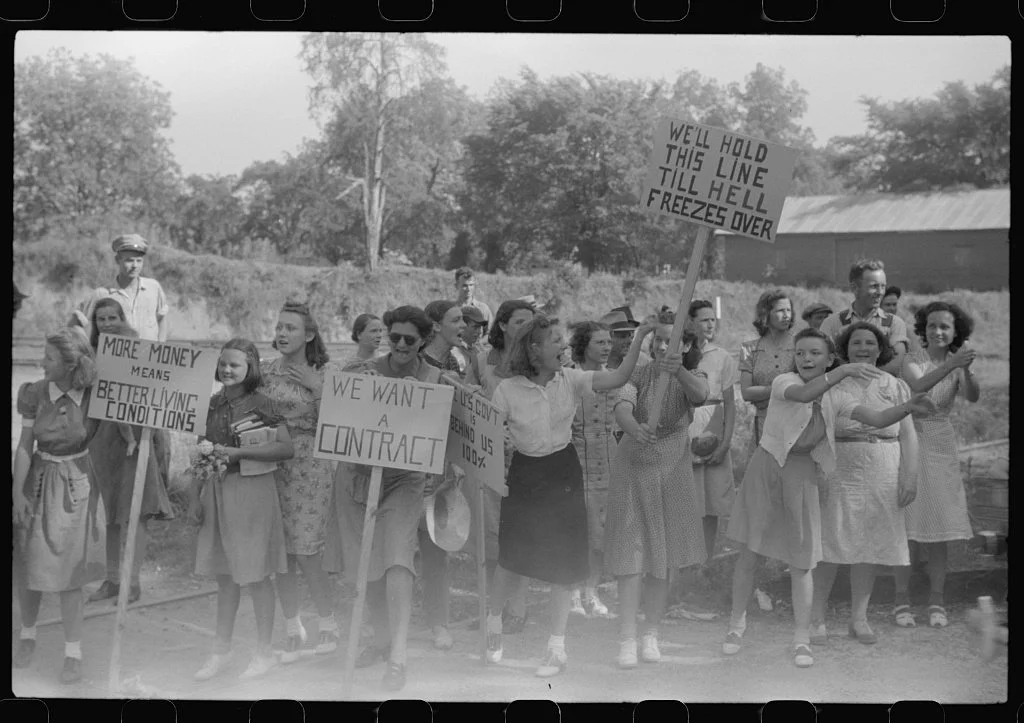
CIO pickets jeering at few workers who were entering a mill in Greensboro, Greene County, Georgia
What Came Before
When we examine the state labor and infrastructure history that has shaped our communities, it becomes clear that the basic comforts of the modern working class were not freely given; they were demanded. Union leverage was the only mechanism capable of forcing that concession.
Before collective bargaining took hold, a worker was often treated as a disposable industrial input, no different than a lump of coal or a yard of steel. The power dynamic was entirely one-sided, dictating grueling hours and dangerous conditions. But when workers realized their collective ability to literally halt the engines of production, that dynamic shifted. The leverage of the organized strike and the picket line didn’t just win incremental wage increases—it fundamentally rewrote the social contract between employer and employee.
So, what did that leverage actually get us? It bought the 40-hour workweek and the very concept of the weekend. It secured overtime pay, enforced baseline workplace safety standards, and helped end the exploitation of child labor in factories.
Most importantly, union leverage ensured that the immense wealth generated by soaring industrial productivity was actually shared with the people physically building the nation. It created an era where a steady income meant a family could afford a home, put food on the table, and save for the future without relying on predatory credit. It proved a simple historical truth: when working class negotiates from a position of unified strength, the economy is forced to work for the people who run it, rather than just the corporations that own it.
The Corporate Counter-Offensive
The gains achieved by organized labor were never accepted as a permanent reality by corporate interests. Almost immediately, a concerted effort began to dismantle the collective power of the working class. This anti-union movement, driven by corporate lobbyists and deeply funded activist networks, systemically sought to weaken the very mechanisms that had built middle-class wealth.
One of their most effective tools has been the deceptively named “Right to Work” laws. The underlying strategy of these laws is simple: drain a union’s resources by legally requiring them to represent and advocated for employees who pay absolutely nothing to sustain the organization. It is a deliberate tactic to hollow out collective bargaining from the inside. Without the necessary resources, a union’s ability to effectively negotiate for better wages, benefits, and safety standards is severely crippled. The data backs this up: workers in states without these laws are more than twice as likely to be protected by a union contract, while full-time workers in “Right to Work” states earn significantly less on average. [1]
This corporate campaign to silence working Americans found its ultimate political champion in the 1980s. When President Ronald Reagan took office, the relationship between the federal government and organized labor fundamentally shifted.
The turning point occurred in August 1981, when over 12,000 air traffic controllers with the Professional Air Traffic Controllers Organization (PATCO) went on strike over long-simmering disputes regarding pay and working conditions. Within hours, Reagan issued and ultimatum from the Rose Garden, demanding they return to work within 48 hours or be terminated. When the workers stood their ground, Reagan fired them, permanently replaced them, and effectively bankrupted and decertified the union. [2]
This was the largest act of union-busting in U.S. history up to that point. The PATCO strike was a watershed moment that defined labor relations for the rest of the century. By taking such a public and aggressive stance, Reagan sent a clear message that emboldened private-sector employers. Corporations across the country followed his lead, aggressively hiring replacement workers to break strikes and force painful concessions from labor unions.
The resulting "bloodbath" of broken strikes had a chilling effect; the annual average of major work stoppages plummeted from roughly 300 per year prior to the strike to an average of just 16 annually by the 2010s [3]. Furthermore, Reagan’s appointees to the National Labor Relations Board systemically narrowed workers’ rights and protections, instituting rules that made it easier for employers to interrogate union supporters and restrict organizing activities—precedents that still harm workers today. The destruction of PATCO wasn’t just about air traffic controllers; it was the starting gun for an era of confident anti-unionism that broke the leverage of the working class and accelerated the staggering inequality we are dealing with today.
The Modern Cost
The systemic shifts we’ve explored—from the erosion of union leverage to the silent tax of inflation—aren’t just academic concepts; they translate into harsh mathematical realities for working families today. When we look at the numbers, it becomes brutally clear how difficult it is for a family to simply break even.
Let’s ground this in the actual costs of living for an average Hoosier family attempting to maintain a basic standard of living. Consider a household consisting of two working adults and two children. According to the MIT Living Wage Calculator, for that family to simply meet their basic needs in Indiana, both adults must each earn an hourly wage of $29.05. [4]
If only one adult is working to support that family of four, the burden skyrockets. That single earner must bring in $54.51 per hours just to reach a living wage. [4] This assumes they are working full-time, putting in 2,080 hours over the course of a year.
This squeeze is heavily driven by the foundational cost of shelter. In Indiana, the typical home value sits around $262,000 [5]. If a family of four is renting a space large enough to accommodate them, such as a four-bedroom unit, the median rent is significantly higher than historical averages. When you add in the necessities—utilities, food, healthcare, childcare, and transportation—the math quickly demonstrates why so many are struggling despite working full-time.
When you compare these required living wages to the federal minimum wage, which remains anchored at a staggering $7.25 an hour [6], the depth of the crisis is undeniable. The modern working squeeze has created an environment where the math simply no longer works for the average family, forcing many into debt just to survive the present, let alone build wealth for the future.
References and Sources
[1] Economic Policy Institute. "Right-to-Work States Still Have Lower Wages." Data on wage disparities and unionization rates in Right-to-Work vs. non-Right-to-Work states.
[2] McCartin, Joseph A. "Collision Course: Ronald Reagan, the Air Traffic Controllers, and the Strike that Changed America." Oxford University Press, 2011. Historical record of the 1981 PATCO strike and mass terminations.
[3] U.S. Bureau of Labor Statistics. "Work Stoppages." Historical data tracking the decline in major work stoppages involving 1,000 or more workers from the 1970s through the 2010s.
[4] Glasmeier, Amy K., and the Massachusetts Institute of Technology. "Living Wage Calculator." Current living wage data specific to Indiana counties and household sizes. [5] Zillow Home Value Index (ZHVI). "Indiana Home Values." Real estate market data reflecting median home values in the state.
[6] U.S. Department of Labor. "Minimum Wage." Current federal minimum wage standards.
